Monday, May 23, 1988

Senegal (c. 20,000 BC) - Percussion - Rhythm


Senegal is south of the Sénégal River in Western Africa, bounded by the Atlantic Ocean to the west, Mauritania to the north, Mali to the east, and Guinea and Guinea-Bissau to the south. The Gambia lies almost entirely within Senegal, surrounded on the north, east and south; from its western coast, Gambia's territory follows the Gambia River more than 186 miles inland. Dakar is the capital city of Senegal, located on the Cape Verde Peninsula on the country's Atlantic coast.

Archaeological findings throughout the area indicate that Senegal was inhabited in prehistoric times.

Prehistory is a term often used to describe the period before written history. Paul Tournal originally coined the term Pré-historique in describing the finds he had made in the caves of southern France. It came into use in French in the 1830's to describe the time before writing, and was introduced into English by Daniel Wilson in 1851.

Prehistory can be said to date back to the beginning of the universe itself, although the term is most often used to describe periods when there was life on Earth; dinosaurs can be described as prehistoric animals and cavemen are described as prehistoric people. Usually the context implies what geologic or prehistoric time period is discussed, e.g. "Middle Palaeolithic Homo sapiens," 20,0000 years ago.


[Village near Podor]

Senegal - Greetings from Podor


[19th-Century French fort at Podor]

Podor is the northernmost town in Senegal, Africa, lying on Morfil Island between the Sénégal River and Doué River.

***


[Idiophones from Southeast Asia]

A solid-body percussion instrument, or idiophone, is any musical instrument which creates sound primarily by way of the instrument vibrating itself, without the use of strings or membranes. It is one of the four main divisions in the original Hornbostel-Sachs scheme of musical instrument classification. Idiophones are probably the oldest type of musical instrument (not counting the human voice). In the early classification of Victor-Charles Mahillon, this group of instruments was called autophones.

Most percussion instruments which are not drums are idiophones. Hornbostel-Sachs divides idiophones into four main sub-categories. The first division is the struck idiophones (sometimes called concussion idiophones). This includes most of the non-drum percussion instruments familiar in the west. They include all idiophones which are made to vibrate by being hit, either directly with a stick or hand (like the wood block, singing bowl, triangle or marimba), or indirectly, by way of a scraping or shaking motion (like maracas or flexatone).

Various types of bells fall into both categories.

The other three sub-divisions are rarer. They are plucked idiophones, such as the jew's harp, amplified cactus, music box or mbira (thumb piano); blown idiophones, of which there are a very small number of examples, the Aeolsklavier being one; and friction idiophones, such as the singing bowl, glass harmonica, glass harp, turntable, verrophone, daxophone, styrophone, musical saw, or nail violin (a number of pieces of metal or wood rubbed with a bow).
A number of idiophones that are normally struck, such as vibraphone bars and cymbals, can also be bowed.

***


The drum, or membranophone, consists of at least one membrane, called a drumhead or drum skin, that is stretched over a shell and struck, either directly with parts of a player's body, or with some sort of implement such as a drumstick, to produce sound. Drums are the world's oldest and most ubiquitous musical instruments, and the basic design has remained virtually unchanged for thousands of years. Most drums are considered "untuned instruments."


The shell almost invariably has a circular opening over which the drumhead is stretched, but the shape of the remainder of the shell varies widely. In the western musical tradition, the most usual shape is a cylinder, although timpani, for example, use bowl-shaped shells. Other shapes include a frame design (tar, Bodhrán), truncated cones (bongo drums, Ashiko), goblet shaped (djembe), and joined truncated cones (talking drum).

Drums with cylindrical shells can be open at one end (as is the case with timbales), or can have two drum heads. Single-headed drums normally consist of a skin which is stretched over an enclosed space, or over one of the ends of a hollow vessel. Drums with two heads covering both ends of a cylindrical shell often have a small hole somewhat halfway between the two heads; the shell forms a resonating chamber for the resulting sound. Exceptions include the African slit drum, made from a hollowed-out tree trunk, and the Caribbean steel drum, made from a metal barrel. Drums with two heads can also have a set of wires, called snares, held across the bottom head, top head, or both heads, hence the name snare drum.

Prior to the invention of tension rods drum skins were attached and tuned by rope systems such as that used on the Djembe or pegs and ropes such as that used on Ewe Drums.

Several factors determine the sound a drum produces, including the type of shell the drum has, the type of drumheads it has, and the tension of the drumheads. Different drum sounds have different uses in music. For example, a jazz drummer may want drums that sound crisp, clean, and a little on the soft side, whereas a rock and roll drummer may prefer drums that sound loud and deep. Because these drummers want different sounds, their drums will be constructed differently.

The drumhead has the most effect on how a drum sounds. Each type of drumhead serves its own musical purpose and has its own unique sound. Thicker drumheads are lower-pitched and can be very loud. Drumheads with a white plastic coating on them muffle the overtones of the drumhead slightly, producing a less diverse pitch. Drumheads with central silver or black dots tend to muffle the overtones even more. And drumheads with perimeter sound rings mostly eliminate overtones . Some jazz drummers avoid using thick drumheads, preferring double ply drumheads or drumheads with perimeter sound rings. Rock drummers often prefer the thicker or coated drumheads.

The second biggest factor affecting the sound produced by a drum is the tension at which the drumhead is held against the shell of the drum. When the hoop is placed around the drumhead and shell and tightened down with bolts, the tension of the head can be adjusted. When the tension is increased, the amplitude of the sound is reduced and the frequency is increased, making the pitch higher and the volume lower.

The type of shell also affects the sound of a drum. Because the vibrations resonate in the shell of the drum, the shell can be used to increase the volume and to manipulate the type of sound produced. The larger the diameter of the shell, the lower the pitch of the drum will be. The type of wood is important as well. Birch generates a bright, crisp, and clean sound, maple reproduces the frequency of the drumhead as it resonates and has a warm, wholesome sound while mahogany raises the frequency of low pitches and keeps higher frequencies at about the same speed. When choosing a set of shells, a jazz drummer may want smaller maple shells, while a rock drummer may want larger birch shells. For more information about tuning drums or the physics of a drum, visit the external links listed below.

Drums are usually played by the hands, or by one or two sticks. In many traditional cultures drums have a symbolic function and are often used in religious ceremonies. Drums are often used in music therapy, especially hand drums, because of their tactile nature and easy use by a wide variety of people.

The earliest known drum-like instrument is from Mezhirich, near Kiev, Ukraine, and dates back to approximately 15,000 years ago. The instrument was found at the site of the oldest known house, constructed of mammoth bones. They were found in 1965 by a farmer digging a new basement six feet below the ground. The drum-like instrument is a hollow mammoth skull with signs of wear from being hit by mammoth bones decorated with red paint.

In the past drums have been used not only for their musical qualities, but also as a means of communication, especially through signals. The talking drums of Africa can imitate the inflections and pitch variations of a spoken language and are used for communicating over great distances. Throughout Sri Lankan history drums have been used for communication between the state and the community, and Sri Lankan drums have a history stretching back over 2500 years. Japanese troops used Taiko drums to motivate troops, to help set a marching pace, and to call out orders or announcements. Fife-and-drum corps of Swiss mercenary foot soldiers also used drums. They used an early version of the snare drum carried over the player's right shoulder, suspended by a strap (typically played with one hand using traditional grip). It is to this instrument that English word "drum" was first used.

***

Rhythm (from Greek - rhythmos, "any measured flow or movement, symmetry") is the variation of the length and accentuation of a series of sounds or other events.

***
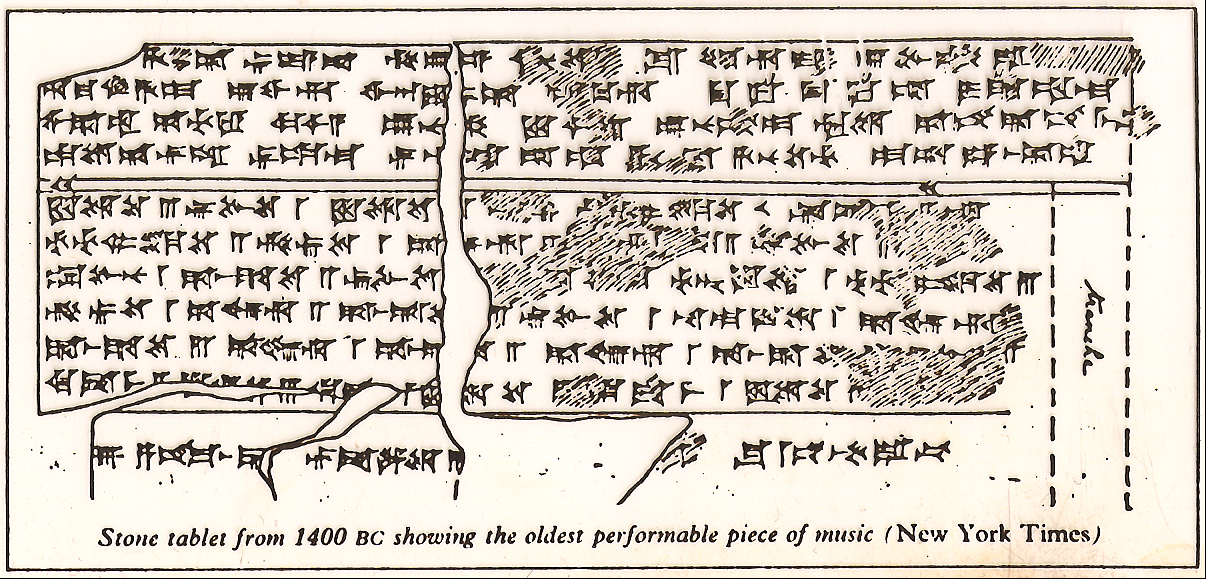


The earliest performable notation comes from Iraq, West Asia (Sumeria, 1400 BC), using letter names for pitch (Korea, in Northwest Asia, developed a related notion).


In Western Europe, a repeating 7-letter notation (ABCDEFGABC....) became supplemented by graphics. Medieval monks began with squiggles called neumes, read left to right through time, with pitch depicted as high or low on the page.


Horizontal staff lines were added, with a clef, specifying a pitch,


such as "G," for high (treble) singers.

***

A clef (from the French for "key") is a musical symbol used to indicate the pitch of written notes.

Placed on one of the lines at the beginning of the staff, it indicates the name and pitch of the notes on that line. This line serves as a reference point by which the names of the notes on any other line or space of the staff may be determined.

These days, the curlicues of the G-clef are almost invariably placed on the second line (from the bottom) of the staff, and is called the "treble clef." This is by far the most common clef used today, and the only G-clef still in use. For this reason, the terms G-clef and treble clef are basically seen as synonymous. It was formerly also known as the "violin clef."

This clef is used for the bagpipes, violin, flutes, oboe, English horn, all clarinets, all saxophones, horn, euphonium (occasionally), trumpet, guitar, vibraphone, xylophone and handbells; for the upper part of keyboard instruments like the piano, organ, harp, and harpsichord (of which the lower part is usually written in the bass clef); for the highest notes played by the cello (the old convention was to write an octave higher, unless preceded by a tenor clef), bassoon, trombone (which otherwise use the bass and tenor clefs), and viola (which otherwise uses the alto clef); and for the soprano, mezzo-soprano, alto, and tenor voices.

***


Squarish neumes with four lines became notes on a five-line staff.


Quarter notes (and their equivalent silent counterparts known as rests) often receive one "beat" or time unit, at any designated speed (tempo, time).


Vertical bar lines were added for measured intervals of time -- the space between bar lines called a "measure." Repeat signs save space, thin double bars end sections, and double bars end pieces.


The repeated notes in Greetings from Podor, could be notated as Middle C Quarter Notes. As the main notes of the piece, they could also be called "I" or "Do." This C is on a ledger line, just below the five-note staff...


Middle C is indeed roughly in the center of a piano keyboard. Any note adjacent to the left of a "gang of two" black notes will be a C.


2/4, 3/4, and 4/4 are meters (time signature). All the notes above are High C's, one octave (eight white notes above Middle C).

"3/4" means 3 beats per measure, with the quarter (1/4) note getting the beat.

The above example shows quarter notes, eighths (half as long as quarters), and sixteenth notes (half as long as eighths).


Other important notes and rests include the half (twice as long as a quarter)

and the whole (twice as long as a half, four times as long as a quarter).

***

Tempo (Italian for 'time, movement') is the speed or pace of a given piece. It is an extremely crucial element of sound, as it can affect the mood and difficulty of a piece.

The plural of tempo in Italian is tempi. Some writers employ this plural when writing in English. Others use the native English plural tempos. Standard dictionaries reflect both usages.

The tempo of a piece will typically be written at the start of a piece of music, and is usually indicated in beats per minute (mm metronome marks). This means that a particular note value (for example, a quarter note) is specified as the beat, and the marking indicates that a certain number of these beats must be played per minute. The greater the tempo, the larger the number of beats that must be played in a minute is and, therefore, the faster a piece must be played. Mathematical tempo markings of this kind became increasingly popular during the first half of the 19th century, after the metronome had been invented by Johann Nepomuk Mälzel, although early metronomes were somewhat inconsistent. Some people consider Beethoven's metronome markings, in particular, to be notoriously unreliable.

As an alternative to metronome markings, some 20th century composers (such as Béla Bartók and John Cage) would give the total execution time of a piece, from which the proper tempo can be roughly derived.

Whether a music piece has a mathematical time indication or not, in classical music it is customary to describe the tempo of a piece by one or more words. Most of these words are Italian, a result of the fact that many of the most important composers of the 17th century were Italian, and this period was when tempo indications were used extensively for the first time.

Before the metronome, words were the only way to describe the tempo of a composition. Yet after the metronome's invention, these words continued to be used, often additionally indicating the mood of the piece, thus blurring the traditional distinction between tempo and mood indicators. For example, presto and allegro both indicate a speedy execution (presto being faster), but allegro also connotes joy (from its original meaning in Italian). Presto, on the other hand, indicates speed as such (while possibly connoting virtuosity, a connotation it did not acquire until the late 18th century).

Additional Italian words also indicate tempo and mood. For example, the "agitato" in the Allegro agitato of the last movement of George Gershwin's piano concerto in F has both a tempo indication (undoubtedly faster than a usual Allegro) and a mood indication ("agitated").

In some cases (quite often up to the end of the Baroque period), conventions governing musical composition were so strong that no tempo had to be indicated. For example, the first movement of Bach's Brandenburg Concerto No. 3 has no tempo or mood indication whatsoever.

To provide movement names, publishers of recordings resort to ad hoc measures, for instance marking the Brandenburg movements "Allegro," "(Allegro)," "(Without indication)," and so on.

In Renaissance music most music was understood to flow at a tempo defined by the tactus, roughly the rate of the human heartbeat. Which note value corresponded to the tactus was indicated by the mensural time signature.

Often a particular musical form or genre implies its own tempo, so no further explanation is placed in the score. Thus musicians expect a minuet to be performed at a fairly stately tempo, slower than a Viennese waltz; a Perpetuum Mobile to be quite fast, and so on. Genres can be used to imply tempos; thus Ludwig van Beethoven wrote "In tempo d'un Menuetto" over the first movement of his Piano Sonata, Op. 54, although that movement is not a minuet. Popular music charts use terms such as "bossa nova", "ballad", and "Latin rock" in much the same way.

It is important to remember when interpreting these words that not only have tempos changed over historical time, and even in different places, but sometimes even the ordering of terms has changed. Thus a modern largo is slower than an adagio, but in the Baroque period it was faster.

From fastest to slowest, the common tempo markings are:

Prestissimo - extremely fast

Vivacissimamente - adverb of vivacissimo, "very quickly and lively"

Vivacissimo - very fast and lively

Presto - very fast

Allegrissimo - very fast

Vivo - lively and fast

Vivace - lively and fast

Allegro (Italian "happy") - fast and bright

Allegro moderato - moderately quick

Allegretto (a "little allegro") - moderately fast (but less so than allegro)

Allegretto grazioso - moderately fast and with grace

Moderato - moderately

Moderato con espressivo - moderately with expression

Andantino - alternatively faster or slower than andante (a rather ambiguous tempo)

Andante - at a walking pace

Tranquillamente - adverb of tranquillo, "tranquilly"

Tranquillo - tranquil

Adagietto - rather slow

Adagio - slow and stately (literally, "at ease")

Grave - slow and solemn

Larghetto - rather broadly

Largo - Very slow, very similar to lento

Lento - very slow

Largamente/Largo - "broadly," very slow

Larghissimo - very slow

Other terms include:

Marcato - marching tempo

Misterioso - mysteriously

Tempo commodo - at a comfortable speed

Tempo giusto - at a consistent, or exact, speed

L'istesso tempo - at the same speed (as before)

Non troppo - not too much (e.g. Allegro ma non troppo, "fast but not too much")

Assai - rather, very, enough as is needed (e.g. Adagio assai)

Con - with (e.g. Andante con moto, "at a walking pace with motion")

Molto - much, very (e.g. Molto allegro)

Poco - a little (e.g. Poco allegro)

Quasi - as if (e.g. Più allegro quasi presto, "faster, as if presto")

tempo di... - the speed of a ... (e.g. Tempo di valse (speed of a waltz), Tempo di marzo/marcia (speed of a march))

All of these markings are based on a few root words such as allegro, largo, adagio, vivace, presto, andante, and lento. By adding the -issimo ending the word is amplified, by adding the -ino ending the word is diminished, and by adding the -etto ending the word is endeared. Many tempos also can be translated with the same meaning, and it is up to the player to interpret the speed that best suits the period, composer, and individual work.

Common qualifiers

assai - very, very much, as in Allegro assai (but also understood by some as "enough")

con brio - with vigour or spirit

con moto - with movement

non troppo - not too much, e.g. Allegro non troppo (or Allegro ma non troppo) means "Fast, but not too much."

non tanto - not so much

molto - much, very, as in Molto allegro (very fast and bright) or Adagio molto

poco - slightly, little, as in Poco adagio

più - more, as in Più allegro; used as a relative indication when the tempo changes

meno - less, as in Meno presto

poco a poco - little by little

In addition to the common allegretto, composers freely apply Italian diminutive and superlative suffixes to various tempo indications: andantino, larghetto, adagietto, and larghissimo.

Some markings that primarily mark a mood (or character) also have a tempo connotation:

Agitato - agitated, with implied quickness

Appasionato - to play passionately

Dolce - sweetly

Espressivo - expressively

Furioso - to play in an angry or furious manner

Giocoso - merrily

Maestoso - majestic or stately (which generally indicates a solemn, slow movement)

Morendo - dying

Sostenuto - sustained, sometimes with a slackening of tempo

Scherzando - playful

Vivace - lively and fast

Composers may use expressive marks to adjust the tempo:

Accelerando - speeding up (abbreviation: accel.)

Allargando - growing broader; decreasing tempo, usually near the end of a piece

Meno mosso - less movement or slower

Mosso - movement, more lively, or quicker, much like più mosso, but not as extreme

Più mosso - more movement or faster

Rallentando - slowing down, especially near the end of a section (abbreviation: rall.)

Ritardando - slowing down (abbreviation: rit. or more specifically, ritard.)

Ritenuto - slightly slower; temporarily holding back. (Note that the abbreviation for ritardando can also be rit. Thus a more specific abbreviation is riten. Also sometimes ritenuto does not reflect a tempo change but a character change instead.)

Rubato - free adjustment of tempo for expressive purposes

Stretto - rushing ahead; temporarily speeding up

Stringendo - pressing on faster

While the base tempo indication (such as allegro) appears in large type above the staff, these adjustments typically appear below the staff or (in the case of keyboard instrument) in the middle of the grand staff.

They generally designate a gradual change in tempo; for immediate tempo shifts, composers normally just provide the designation for the new tempo. (Note, however, that when Più Mosso or Meno Mosso appears in large type above the staff, it functions as a new tempo, and thus implies an immediate change.) Several terms control how large and how gradual this change are:

poco a poco - bit by bit, gradually

subito - suddenly

poco - a little

molto - a lot

assai - quite a lot, very

After a tempo change, a composer may return to a previous tempo in two different ways:
a tempo - returns to the base tempo after an adjustment (e.g. "ritardando ... a tempo" undoes the effect of the ritardando).

Tempo primo or Tempo I - denotes an immediate return to the piece's original base tempo after a section in a different tempo (e.g. "Allegro ... Lento ... Tempo I" indicates a return to the Allegro). This indication often functions as a structural marker in pieces in binary form.

These terms also indicate an immediate, not a gradual, tempo change. Although they are Italian, composers typically use them even if they have written their initial tempo marking in some other language.

Although Italian has been the prevalent language for tempo markings throughout most of classical music history, many composers have written tempo indications in their own language.

Several composers have written markings in French, among them baroque composers François Couperin and Jean-Philippe Rameau as well as Claude Debussy, Olivier Messiaen, Maurice Ravel and Alexander Scriabin. Common tempo markings in French are:

Rapide - fast

Vite - fast

Vif - lively

Très - very, as in Très vif (very lively)

Modéré - at a moderate tempo

Moins - less, as in Moins vite (less fast)

Lent - slowly

Grave - slowly and solemnly

Au mouvement - play the (first or main) tempo.

Many composers (including Gustav Mahler and Arnold Schoenberg) have used German tempo markings. Typical German tempo markings are:

Schnell — fast

Rasch — quickly

Lebhaft — lively (mood)

Mäßig — moderately

Langsam — slowly

One of the first German composers to use tempo markings in his native language was Ludwig van Beethoven. The one using the most elaborate combined tempo and mood markings was probably Gustav Mahler. For example, the second movement of his Symphony No. 9 is marked Im tempo eines gemächlichen Ländlers, etwas täppisch und sehr derb, indicating a slowish folk-dance–like movement, with some awkwardness and vulgarity in the execution. Mahler would also sometimes combine German tempo markings with traditional Italian markings, as in the first movement of his Symphony No. 6, marked Allegro energico, ma non troppo. Heftig, aber markig.

English indications, for example quickly, have also been used, by Benjamin Britten and Percy Grainger, among many others.

***

Meter is a concept related to an underlying division of time, the measurement of a musical line into measures of stressed and unstressed "beats," indicated in Western music notation by a symbol called a time signature.

Ametric music includes chant, some graphically scored works since the 1950's, and non-European music such as Honkyoku repertoire for shakuhachi.

Polymeter or Polyrhythm is the use of two or more metric frameworks simultaneously, or in regular alternation

[1990 France Pitch / 1988 Senegal Rhythm / 1987 France Aerophone]

Thursday, January 1, 1987

France (c. 28,000 BC) - Horn - Aerophone

 
The Venus of Laussel is a Venus figurine, a 1.5 foot high limestone bas-relief of a nude female figure, painted with red ochre, and is approximately 28,000 years old (Aurignacian).


[Anonymous French (b. c. 1170)
La Seconde Estampie Real (c. 1200]


The figure holds a wisent horn...

[The wisent (pronounced /ˈviːzənt/), or European bison (Bison bonasus), is a bison species and the heaviest surviving land animal in Europe. A typical wisent is about 2.9 m (9.5 ft) long and 1.8–2.2 m (5.9–7.4 ft) tall, and weighs 300–920 kg (660–2000 lb). It is typically smaller than the related American bison (Bison bison), and has shorter hair on the neck, head, and forequarters, but longer tail and horns. Wisent are now forest-dwelling. They have few predators (besides humans) with only scattered reports from the 1800s of wolf and bear predation. Wisent were first scientifically described by Carolus Linnaeus in 1758. Some later descriptions treat the wisent as conspecific with the American bison. It is not to be confused with the aurochs, the extinct ancestor of domestic cattle.]


[California poster from, of course, way later]

...or possibly a cornucopia...

[The cornucopia (Latin: Cornu Copiae) is a symbol of food and abundance dating back at least to the 5th Century BC, also referred to as Horn of Plenty, Horn of Amalthea, and harvest cone.
In Greek mythology, Amalthea raised Zeus on the milk of a goat. In return Jupiter gave Amalthea the goat's horn. It had the power to give to the person in possession of it whatever he or she wished for. This gave rise to the legend of the cornucopia. The original depictions were of the goat's horn filled with fruits and flowers: deities, especially Fortuna, would be depicted with the horn of plenty. The cornucopia was also a symbol for a woman's fertility. In modern depiction, the cornucopia is typically a hollow, horn-shaped wicker basket typically filled with various kinds of festive fruit and vegetables. In North America, the cornucopia has come to be associated with Thanksgiving and the harvest.]

...in one hand, which has 13 notches. According to some researchers, this may symbolise the number of moons or the number of menstrual cycles in one year. She has her hand on her abdomen (or womb), with large breasts and vulva. There is a "Y" on her thigh and her faceless head is turned toward the horn.

At least one writer (flutist and author James Galway) maintains that the horn decpicted is a musical one. If so, the woman is holding it in the manner of a medieval gemshorn (i.e. bell towards mouth).


The figure was rediscovered in 1911 by J. G. Lalanne, a physician. It was carved into the wall of a limestone rock shelter (abri de Laussel) on the territory of the commune of Marquay, in the Dordogne department of southwestern France. It is now in the Musée d'Aquitaine, in Bordeaux, France.

***


An aerophone is any musical instrument which produces sound primarily by causing a body of air to vibrate, without the use of strings or membranes, and without the vibration of the instrument itself adding considerably to the sound. It is one of the five main classes (class 4, although with respect to traditional western classifications of instruments, corresponding to the "woodwinds and brass" of symphony orchestras, which tend to be located toward the top of pages in full scores) of instruments in the original Hornbostel-Sachs scheme of musical instrument classification.

Hornbostel-Sachs divides aerophones by whether vibrating air is contained in the instrument itself or not.


The first class (41) includes instruments where the vibrating air is not contained by the instrument itself, such as the bullroarer. Such instruments are called free aerophones. This class includes free reed instruments, such as the harmonica, but also many instruments unlikely to be called wind instruments at all by most people, such as sirens and whips.


The second class (42) includes instruments where the vibrating air is contained by the instrument. This class includes almost all the instruments generally called wind instruments in the west, such as the flute, sheng, oboe, and trombone.

Additionally, very loud sounds can be made by explosions directed into, or being detonated inside of resonant cavities. Instruments such as the calliope (and steam whistle), as well as the pyrophone (fire/explosion organ[!]) might thus be considered as class 42 instruments, despite the fact that the "wind" or "air" may be steam or an air-fuel mixture.

[1988 Senegal / 1987 France / 1985 Tanzania]

Tuesday, January 1, 1985

Tanzania (2,500,000 BC) - Olduvai - Voice


Olduvai Gorge or Oldupai Gorge is commonly referred to as "The Cradle of Mankind," or shall we say "Humankind."


It is a steep-sided ravine in the Great Rift Valley,


which stretches along eastern Africa.


[Tanzania - Zaramo - Mitamba Yalagala Kumchuzi (before 1984)]


Olduvai is in the eastern Serengeti Plains in northern Tanzania and is about 30 miles long. The gorge is named after the Maasai word for the wild sisal plant Sansevieria ehrenbergii, commonly called Oldupaai.


[Most likely not a scene from Olduvai Gorge]

It is one of the most important prehistoric sites in the world and has been instrumental in furthering understanding of early human evolution. Excavation work there was pioneered by Louis and Mary Leakey in the 1950s and continued into the 21st Century by Professor Fidelis Masao of the Open University of Tanzania supported by Earthwatch; there have also been teams from Rutgers University. Millions of years ago, the site was that of a large lake, the shores of which were covered with successive deposits of volcanic ash. Around 500,000 years ago seismic activity diverted a nearby stream which began to cut down into the sediments, revealing seven main layers in the walls of the gorge.

The stratigraphy is extremely deep and layers of volcanic ash and stones allow radiometric dating of the embedded artifacts, mostly through potassium-argon dating. The first artifacts in Olduvai (pebble tools and choppers) date to circa 2 million years ago but fossil remains of human ancestors have been found from as long as 2.5 million years ago.

The earliest archaeological deposit, known as Bed I, has produced evidence of campsites and living floors along with stone tools made of flakes from local basalt and quartz. Since this is the site where these kinds of tools were first discovered, these tools are called Oldowan. It is now thought that the Oldowan toolmaking tradition started about 2.6 million years ago. Bones from this layer are not of modern humans but primitive hominid forms of Paranthropus boisei and the first discovered specimens of Homo habilis.

The Olduvai Gorge bears the distinction of having the oldest known evidence of Elephant consumption, attributed to Homo ergaster around 1.8 million years ago.

Above this, in Bed II, pebble tools begin to be replaced by more sophisticated handaxes of the Acheulean industry and made by Homo ergaster. This layer dates to around 1.5 million years ago.

Beds III and IV have produced Acheulean tools and fossil bones from more than 600,000 years ago.

During a period of major faulting and volcanism roughly 400,000 to 600,000 years ago, the Masek Beds were made.

Beds above these contained tools from a Kenya-Capsian industry made by modern humans and are termed the Masek Beds (600,000 to 400,000 years ago), the Ndutu Beds (400,000 to 32,000 years ago), and the Naisiusiu Beds (22,000 to 15,000 years ago).

***


[Human Vocal Cords]

The human voice consists of sound made by a human being using the vocal folds for talking, singing, laughing, crying, screaming, etc. Human voice is specifically that part of human sound production in which the vocal folds (vocal cords) are the primary noise source. Generally speaking, the voice can be subdivided into three parts; the lungs, the vocal folds, and the articulators. The lung (the pump) must produce adequate airflow to vibrate vocal folds (air is the fuel of the voice). The vocal folds (vocal cords) are the vibrators, neuromuscular units that ‘fine tune’ pitch and tone. The articulators (vocal tract consisting of tongue, palate, cheek, lips, etc.) articulate and filter the sound.

The vocal folds, in combination with the articulators, are capable of producing highly intricate arrays of sound.

The tone of voice may be modulated to suggest emotions such as anger, surprise, or happiness.

Singers use the human voice as an instrument for creating music.

Men and women have different vocal folds sizes; adult male voices are usually lower-pitched and have larger folds. The male vocal folds (which would be measured vertically in the opposite diagram), are between 17 mm and 25 mm in length.

Matching the female body, which on the whole has less muscle than the male, females have smaller folds. The female vocal folds are between 12.5 mm and 17.5 mm in length.

As seen in the illustration, the folds are located just above the trachea (the windpipe which travels from the lungs). Food and drink do not pass through the cords but instead pass through the esophagus, an unlinked tube. Both tubes are separated by the epiglottis, a "flap" that covers the opening of the trachea while swallowing. When food goes down through the cords and trachea (can occur when a person inhales while swallowing), aspiration and possibly choking result.

The folds in both sexes are within the larynx. They are attached at the back (side nearest the spinal cord) to the arytenoid cartilages, and at the front (side under the chin) to the thyroid cartilage. They have no outer edge as they blend into the side of the breathing tube (the illustration is out of date and does not show this well) while their inner edges or "margins" are free to vibrate (the hole). They have a three layer construction of an epithelium, vocal ligament, then muscle (vocalis muscle), which can shorten and bulge the folds. They are flat triangular bands and are pearly white in color. Above both sides of the vocal cord is the vestibular fold or false vocal cord, which has a small sac between its two folds (not illustrated).

The difference in vocal folds size between men and women means that they have differently pitched voices. Additionally, genetics also causes variances amongst the same sex, with men and women's singing voices being categorized into types. For example, among men, there are basses, baritones and tenors, and contraltos, mezzo-sopranos and sopranos among women. There are additional categories for operatic voices. This is not the only source of difference between male and female voice. Men, generally speaking, have a larger vocal tract, which essentially gives the resultant voice a lower tonal quality. This is mostly independent of the vocal folds themselves.

The sound of each individual's voice is entirely unique not only because of the actual shape and size of an individual's vocal cords but also due to the size and shape of the rest of that person's body. Humans have vocal folds which can loosen, tighten, or change their thickness, and over which breath can be transferred at varying pressures. The shape of chest and neck, the position of the tongue, and the tightness of otherwise unrelated muscles can be altered. Any one of these actions results in a change in pitch, volume, timbre, or tone of the sound produced. Sound also resonates within different parts of the body, and an individual's size and bone structure can affect the sound produced by an individual.

Singers can also learn to project sound in certain ways so that it resonates better within their vocal tract. This is known as vocal resonation. Another major influence on vocal sound and production is the function of the larynx which people can manipulate in different ways to produce different sounds. These different kinds of laryngeal function are described as different kinds of vocal registers.

The primary method for singers to accomplish this is through the use of the Singer's Formant; which has been shown to match particularly well to the most sensitive part of the ear's frequency range.

Vocal registration refers to the system of vocal registers within the human voice. A register in the human voice is a particular series of tones, produced in the same vibratory pattern of the vocal folds, and possessing the same quality. Registers originate in laryngeal function. They occur because the vocal folds are capable of producing several different vibratory patterns. Each of these vibratory patterns appears within a particular range of pitches and produces certain characteristic sounds.

The term register can be somewhat confusing at it encompasses several aspects of the human voice. The term register can be used to refer to any of the following:

A particular part of the vocal range such as the upper, middle, or lower registers.

A resonance area such as chest voice or head voice.

A phonatory process.

A certain vocal timbre.

A region of the voice which is defined or delimited by vocal breaks.

A subset of a language used for a particular purpose or in a particular social setting.

In linguistics, a register language is a language which combines tone and vowel phonation into a single phonological system.

Within speech pathology the term vocal register has three constituent elements: a certain vibratory pattern of the vocal folds, a certain series of pitches, and a certain type of sound.

Speech pathologists identify four vocal registers based on the physiology of laryngeal function:

the vocal fry register, the modal register, the falsetto register, and the whistle register. This view is also adopted by many vocal pedagogists.

Vocal resonation is the process by which the basic product of phonation is enhanced in timbre and/or intensity by the air-filled cavities through which it passes on its way to the outside air.

Various terms related to the resonation process include amplification, enrichment, enlargement, improvement, intensification, and prolongation, although in strictly scientific usage acoustic authorities would question most of them. The main point to be drawn from these terms by a singer or speaker is that the end result of resonation is, or should be, to make a better sound.

There are seven areas that may be listed as possible vocal resonators. In sequence from the lowest within the body to the highest, these areas are the chest, the tracheal tree, the larynx itself, the pharynx, the oral cavity, the nasal cavity, and the sinuses.

The 12-tone musical scale, upon which the majority of the world's music is based, may have its roots in the sound of the human voice during the course of evolution, according to a study published by the New Scientist. Analysis of recorded speech samples found peaks in acoustic energy that mirrored the distances between notes in the twelve-tone scale.

[1987 France / 1985 Tanzania / 1981 Earth]

Thursday, January 1, 1981

Earth (c. 4,540,000,000 BC) - Sound - Music


Earth is the third planet from the Sun and is the largest of the terrestrial planets in the Solar System in diameter, mass and density. It is also referred to as the Earth, Planet Earth, the World, and Terra.

Home to millions of species, including humans, Earth is the only place in the universe where life is known to exist. Scientific evidence indicates that the planet formed 4.54 billion years ago, and life appeared on its surface within a billion years. Since then, Earth's biosphere has significantly altered the atmosphere and other abiotic conditions on the planet, enabling the proliferation of aerobic organisms as well as the formation of the ozone layer which, together with Earth's magnetic field, blocks harmful radiation, permitting life on land.


Earth's outer surface is divided into several rigid segments, or tectonic plates, that gradually migrate across the surface over periods of many millions of years. About 71% of the surface is covered with salt-water oceans, the remainder consisting of continents and islands; liquid water, necessary for all known life, is not known to exist on any other planet's surface. Earth's interior remains active, with a thick layer of relatively solid mantle, a liquid outer core that generates a magnetic field, and a solid iron inner core.

Earth interacts with other objects in outer space, including the Sun and the Moon. At present, Earth orbits the Sun once for every roughly 366.26 times it rotates about its axis. This length of time is a sidereal year, which is equal to 365.26 solar days.

The Earth's axis of rotation is tilted 23.4° away from the perpendicular to its orbital plane, producing seasonal variations on the planet's surface with a period of one tropical year (365.24 solar days). Earth's only known natural satellite, the Moon, which began orbiting it about 4.53 billion years ago, provides ocean tides, stabilizes the axial tilt and gradually slows the planet's rotation. A cometary bombardment during the early history of the planet played a role in the formation of the oceans.

Later, asteroid impacts caused significant changes to the surface environment.

 
Sound is vibration transmitted through a gas (usually air), liquid, or solid;


particularly, those vibrations composed of frequencies capable of being detected by ears.


For humans, hearing is limited to frequencies between about 20 Hz and 20,000 Hz (20 kHz), with the upper limit generally decreasing with age. Other species have a different range of hearing. For example, dogs can perceive vibrations higher than 20 kHz. As a signal perceived by one of the major senses, sound is used by many species for detecting danger, navigation, predation, and communication.

Any physical phenomena on earth -- such as


fire,


volcanism,


[Alan Hovhaness (1911-2000)
Symphony No. 50 ("Mount St. Helens"), Op. 360: III (1982)


storm,


wind,


and surf -- produce (and are characterized by) unique sounds.


Many animals (such as bees,


frogs,


dinosaurs [probably -- sure, why not?],


birds,


whales,


and primates -- have also developed special organs to produce sound.

In some species, these have evolved to produce song and (in humans) speech. Furthermore, humans have developed culture and technology (such as music, telephony, and radio) that allows them to generate, record, transmit, and broadcast sound.


[Alien - "In space, no one can here you scream" -- i.e. no medium of transmission!]

The mechanical vibrations that can be interpreted as sound can travel through all forms of matter: gases, liquids, solids, and plasmas. However, sound cannot propagate through vacuum. The matter that supports the sound is called the medium.

Sound is transmitted through gases, plasma, and liquids as longitudinal waves, also called compression waves. Through solids, however, it can be transmitted as both longitudinal and transverse waves. Longitudinal sound waves are waves of alternating pressure deviations from the equilibrium pressure, causing local regions of compression and rarefaction, while transverse waves in solids, are waves of alternating shear stress.

Matter in the medium is periodically displaced by a sound wave, and thus oscillates. The energy carried by the sound wave converts back and forth between the potential energy of the extra compression (in case of longitudinal waves) or lateral displacement strain (in case of transverse waves) of the matter and the kinetic energy of the oscillations of the medium.

Sound waves are characterized by the generic properties of waves, which are frequency, wavelength, period, amplitude, intensity, speed, and direction (sometimes speed and direction are combined as a velocity vector, or wavelength and direction are combined as a wave vector).

Transverse waves, also known as shear waves, have an additional property of polarization.

Sound characteristics can depend on the type of sound waves (longitudinal versus transverse) as well as on the physical properties of the transmission medium.


[Sine waves having the same amplitude, but different frequencies]

Whenever the pitch of the soundwave is affected by some kind of change, the distance between the sound wave maxima also changes, resulting in a change of frequency.


[Sine wave with a larger amplitude than any in the previous visual]

When the loudness of a soundwave changes, so does the amount of compression in airwave that is travelling through it, which in turn can be defined as amplitude.

The speed of sound depends on the medium through which the waves are passing, and is often quoted as a fundamental property of the material. In general, the speed of sound is proportional to the square root of the ratio of the elastic modulus (stiffness) of the medium to its density. Those physical properties and the speed of sound change with ambient conditions. For example, the speed of sound in gases depends on temperature. In air at sea level, the speed of sound is approximately 767.3 mph, in fresh water 3,315.1 mph (both at 20 °C, or 68 °F), and in steel about 13,332.1 mph.[2] The speed of sound is also slightly sensitive (a second-order effect) to the sound amplitude, which means that there are nonlinear propagation effects, such as the production of harmonics and mixed tones not present in the original sound (see parametric array).

The scientific study of the propagation, absorption, and reflection of sound waves is called acoustics. Noise is a term often used to refer to an unwanted sound. In science and engineering, noise is an undesirable component that obscures a wanted signal.

Sound pressure is defined as the difference between the average local pressure of the medium outside of the sound wave in which it is traveling through (at a given point and a given time) and the pressure found within the sound wave itself within that same medium. A square of this difference (i.e. a square of the deviation from the equilibrium pressure) is usually averaged over time and/or space, and a square root of such average is taken to obtain a root mean square (RMS) value. For example, 1 Pa RMS sound pressure in atmospheric air implies that the actual pressure in the sound wave oscillates between (1 atm Pa) and (1 atm Pa), that is between 101323.6 and 101326.4 Pa. Such a tiny (relative to atmospheric) variation in air pressure at an audio frequency will be perceived as quite a deafening sound, and can cause hearing damage, according to the table below.

As the human ear can detect sounds with a very wide range of amplitudes, sound pressure is often measured as a level on a logarithmic decibel scale.

Since the human ear does not have a flat spectral response, sound pressures are often frequency weighted so that the measured level will match perceived levels more closely. The International Electrotechnical Commission (IEC) has defined several weighting schemes. A-weighting attempts to match the response of the human ear to noise and A-weighted sound pressure levels are labeled dBA. C-weighting is used to measure peak levels.

Equipment for generating or using sound includes musical instruments, hearing aids, sonar systems and sound reproduction and broadcasting equipment. Many of these use electro-acoustic transducers such as microphones and loudspeakers.


Attack - How quickly a sound reaches full volume after it begins.

Decay - How quickly the sound drops after the initial peak.

Sustain - The steadiness of the sound after its attack.

Release - How quickly the sound fades when a note ends.

***


Music is an art form in which the medium is sound. Common elements of music are rhythm (and its associated concepts tempo, meter, and articulation), pitch (which governs melody and harmony), dynamics, and the sonic qualities of timbre and texture. The word derives from Greek (mousike), "(art) of the Muses."

***


In Greek mythology, the Muses (Ancient Greek hai moũsai: perhaps from the Proto-Indo-European root *men- "think") are a sisterhood of goddesses or spirits, their number set at nine by Classical times, who embody the arts and inspire the creation process with their graces through remembered and improvised song and stage, writing, traditional music, and dance. They were water nymphs, associated with the springs of Helicon and with Pieris, from which they are sometimes called the Pierides. The Olympian system set Apollo as their leader, Apollon Mousagetēs. Not only are the Muses explicitly used in modern English to refer to an inspiration, as when one cites his/her own artistic muse, but they are also implicit in the words "amuse" or "musing upon."

According to Hesiod's Theogony (seventh century BC), they are the daughters of Zeus, king of the gods, and Mnemosyne, goddess of memory. For Alcman and Mimnermus, they were even more primordial, springing from Uranus and Gaia. Pausanias records a tradition of two generations of Muses; the first being daughters of Uranus and Gaia, the second of Zeus and Mnemosyne. Another, rarer genealogy is that they are daughters of Harmonia (the daughter of Aphrodite and Ares) which contradicts the myth in which they were dancing at the wedding of Harmonia and Cadmus.

***


[Raphael Sanzio (1483-1520) - The School of Athens]

Greek philosophers and


Ancient Indians defined music as tones ordered horizontally as melodies, and vertically as harmonies.


Edgar Varese defined the term as simply"organized sound."


[Edgar Varese - Poeme Electronique]


John Cage even partially questioned the "organized" notion, in such works as his notorious


4'33" --


a work featuring


no intentionally-made sound (yet still, as can be seen from the movements in the printed program, durationally delimited -- although, note the ambiguity of the listing "4 Pieces" -- seemingly a double performance...).


According to musicologist Jean-Jacques Nattiez, "the border between music and noise is always culturally defined--which implies that, even within a single society, this border does not always pass through the same place; in short, there is rarely a consensus.... By all accounts there is no single and intercultural universal concept defining what music might be, except that it is "sound through time"

The creation, performance, significance, and even the definition of music vary according to culture and social context. Music ranges from strictly organized compositions (and their recreation in performance), through improvisational music to aleatoric forms. Music can be divided into genres and sub-genres, although the dividing lines and relationships between music genres are often subtle, sometimes open to individual interpretation, and occasionally controversial. Within "the arts," music can be classified as a performing art, a fine art, or an auditory art form.

The development of music among humans must have taken place against the backdrop of natural sounds such as birdsong and the sounds other animals use to communicate.

Prehistoric music is the name which is given to all music produced in preliterate cultures.

***

In music, timbre (from Fr. timbre ) is the quality of a musical note or sound that distinguishes different types of sound production, such as voices or musical instruments. The physical characteristics of sound that mediate the perception of timbre include spectrum and envelope.

Timbre is also known in psychoacoustics as sound quality or sound color.

For example, timbre is what, with a little practice, people use to distinguish the saxophone from the trumpet, even if both instruments are playing notes at the same pitch and amplitude.

The Chinese developed a sophisticated understanding of the musical quality of timbre during the Song Dynasty.

They discovered that the timbre of string instruments could be changed depending on how the strings were touched. Strings could be plucked, brushed, hit, scraped, or rubbed to produce different sounds. The Chinese composed music on the Qin, a long, wooden board with strings. Their Qin songs emphasized the timbre, and the changes in sound could be heard throughout the musical piece.

Tone color is also often used as a synonym. People who experience synesthesia may see certain colors when they hear particular instruments. Helmholtz used the German Klangfarbe (tone color), and Tyndall proposed an English translation, clangtint.

The American Standards Association defines timbre as "[...] that attribute of sensation in terms of which a listener can judge that two sounds having the same loudness and pitch are dissimilar." A note to the 1960 definition adds that "timbre depends primarily upon the spectrum of the stimulus, but it also depends upon the waveform, the sound pressure, the frequency location of the spectrum, and the temporal characteristics of the stimulus."

J.F. Schouten (1968, p.42) describes the "elusive attributes of timbre" as "determined by at least five major acoustic parameters" which Robert Erickson (1975) finds "scaled to the concerns of much contemporary music":

The range between tonal and noiselike character.
The spectral envelope.
The time envelope in terms of rise, duration, and decay.
The changes both of spectral envelope (formant-glide) and fundamental frequency (micro-intonation).
The prefix, an onset of a sound quite dissimilar to the ensuing lasting vibration.

The richness of a sound or note produced by a musical instrument is sometimes described in terms of a sum of a number of distinct frequencies. The lowest frequency is called the fundamental frequency and the pitch it produces is used to name the note. For example, in western music, instruments are normally tuned to A = 440 Hz. Other significant frequencies are called overtones of the fundamental frequency, which may include harmonics and partials. Harmonics are whole number multiples of the fundamental frequency — ×2, ×3, ×4, etc.

Partials are other overtones. Most western instruments produce harmonic sounds, but many instruments produce partials and inharmonic tones, such as cymbals and other non-pitched instruments.

When the orchestral tuning note is played, the sound is a combination of 440 Hz, 880 Hz, 1320 Hz, 1760 Hz and so on. The balance of the amplitudes of the different frequencies is responsible for the characteristic sound of each instrument.

The fundamental is not necessarily the strongest component of the overall sound. But it is implied by the existence of the harmonic series -- the A above would be distinguishable from the one an octave below (220 Hz, 440 Hz, 660 Hz, 880 Hz) by the presence of the third harmonic, even if the fundamental were indistinct. Similarly, a pitch is often inferred from non-harmonic spectra, supposedly through a mapping process, an attempt to find the closest harmonic fit.

The timbre of a sound is also greatly affected by the following aspects of its envelope: attack time and characteristics, decay, sustain, release (ADSR envelope) and transients. Thus these are all common controls on synthesizers. For instance, if one takes away the attack from the sound of a piano or trumpet, it becomes more difficult to identify the sound correctly, since the sound of the hammer hitting the strings or the first blat of the player's lips are highly characteristic of those instruments. The envelope is the overall amplitude structure of a sound, so called because the sound just "fits" inside its envelope: what this means should be clear from a time-domain display of almost any interesting sound, zoomed out enough that the entire waveform is visible.

[1985 Tanzania / 1981 Earth / 1980 Solar System]

Tuesday, January 1, 1980

The Solar System (c. 4,600,000 BC) - Oscillation


The Solar System initially formed 4.6 billion years ago with the gravitational collapse of a small part of a giant molecular cloud. Most of the collapsing mass collected in the center, forming the Sun, while the rest flattened into a protoplanetary disc out of which the planets, moons, asteroids, and other small Solar System bodies formed.

This widely accepted model, known as the nebular hypothesis, was first developed in the 18th century by Emanuel Swedenborg, Immanuel Kant, and Pierre-Simon Laplace. Its subsequent development has interwoven a variety of scientific disciplines including astronomy, physics, geology, and planetary science. Since the dawn of the space age in the 1950s and the discovery of extrasolar planets in the 1990s, the models have been both challenged and refined to account for new observations.

Beginning with the initial formation, the Solar System has evolved considerably. Many moons formed from circling discs of gas and dust around their parent planets, while many other moons are believed to have been captured or (in the case of the Earth's Moon) to have resulted from a giant collision. Collisions between bodies have occurred continuously up to the present day and are central to the evolution of the system. The planets' positions often shifted outward or inward, and planets have switched places. This planetary migration is now believed to be responsible for much of the Solar System's early evolution.

Just as the Sun and planets were born, they will eventually die. In roughly 5 billion years, the Sun will cool and bloat outward to many times its current diameter (becoming a red giant) before casting off its outer layers as a planetary nebula and leaving behind a stellar corpse known as a white dwarf. The planets will follow the Sun's course; in the far distant future, the gravity of passing stars will gradually whittle away at the Sun's retinue of planets. Some will be destroyed, others will be ejected into interstellar space, but ultimately, over the course of trillions of years, the Sun will be left alone with no other bodies in orbit. The Solar System (or Solar system, solar system[a]) consists of the Sun and those celestial objects bound to it by gravity. These objects are the eight planets and their 166 known moons; three dwarf planets (Ceres, Pluto, and Eris) and their four known moons; and billions of small bodies, including asteroids, Kuiper belt objects, comets, meteoroids, and interplanetary dust.

In broad terms, the charted regions of the Solar System consist of the Sun, four terrestrial inner planets, an asteroid belt composed of small rocky bodies, four gas giant outer planets, and a second belt, the Kuiper belt, composed of icy objects. Beyond the Kuiper belt is the scattered disc, the heliopause, and ultimately the hypothetical Oort cloud.
In order of their distances from the Sun,

the terrestrial planets are:

Mercury
Venus
Earth
Mars

The outer gas giants (or Jovians) are:

Jupiter
Saturn
Uranus
Neptune

The three dwarf planets are

Ceres, the largest object in the asteroid belt;
Pluto, the largest known object in the Kuiper belt;
Eris, the largest known object in the scattered disc.

Six of the eight planets and two of the dwarf planets are in turn orbited by natural satellites, usually termed "moons" after Earth's Moon, and each of the outer planets is encircled by planetary rings of dust and other particles. All the planets except Earth are named after deities from Greco-Roman mythology.

A planet is any body in orbit around the Sun that has enough mass to form itself into a spherical shape and has cleared its immediate neighbourhood of all smaller objects. By this definition, the Solar System has eight known planets: Mercury, Venus, Earth, Mars, Jupiter, Saturn, Uranus, and Neptune. From the time of its discovery in 1930 until 2006, Pluto was considered the Solar System's ninth planet. But in the late 20th and early 21st centuries, many objects similar to Pluto were discovered in the outer Solar System, most notably Eris, which is slightly larger than Pluto. On August 24, 2006, the International Astronomical Union defined the term "planet" for the first time, excluding Pluto and reclassifying it under the new category of dwarf planet along with Eris and Ceres.

A dwarf planet is not required to clear its neighbourhood of other celestial bodies. Other objects that may become classified as dwarf planets are Sedna, Orcus, and Quaoar.

The remainder of the objects in orbit around the Sun are small Solar System bodies (SSSBs).

Natural satellites, or moons, are those objects in orbit around planets, dwarf planets and SSSBs, rather than the Sun itself.

Astronomers usually measure distances within the Solar System in astronomical units (AU). One AU is the approximate distance between the Earth and the Sun, or roughly 149,598,000 km (93,000,000 mi). Pluto is roughly 38 AU from the Sun while Jupiter lies at roughly 5.2 AU. One light-year, the best known unit of interstellar distance, is roughly 63,240 AU. A body's distance from the Sun varies in the course of its year. Its closest approach to the Sun is called its perihelion, while its farthest distance from the Sun is called its aphelion.

Informally, the Solar System is sometimes divided into separate zones. The inner Solar System includes the four terrestrial planets and the main asteroid belt. Some define the outer Solar System as comprising everything beyond the asteroids.

Others define it as the region beyond Neptune, with the four gas giants considered a separate "middle zone."

The principal component of the Solar System is the Sun, a main sequence G2 star that contains 99.86% of the system's known mass and dominates it gravitationally.

Jupiter and Saturn, the Sun's two largest orbiting bodies, account for more than 90% of the system's remaining mass.

Most large objects in orbit around the Sun lie near the plane of Earth's orbit, known as the ecliptic. The planets are very close to the ecliptic while comets and Kuiper belt objects are usually at significantly greater angles to it.

All of the planets and most other objects also orbit with the Sun's rotation (counter-clockwise, as viewed from above the Sun's north pole). There are exceptions, such as Halley's Comet.
Objects travel around the Sun following Kepler's laws of planetary motion. Each object orbits along an approximate ellipse with the Sun at one focus of the ellipse. The closer an object is to the Sun, the faster it moves. The orbits of the planets are nearly circular, but many comets, asteroids and objects of the Kuiper belt follow highly elliptical orbits.

To cope with the vast distances involved, many representations of the Solar System show orbits the same distance apart. In reality, with a few exceptions, the farther a planet or belt is from the Sun, the larger the distance between it and the previous orbit. For example, Venus is approximately 0.33 AU farther out than Mercury, while Saturn is 4.3 AU out from Jupiter, and Neptune lies 10.5 AU out from Uranus. Attempts have been made to determine a correlation between these orbital distances (see Titius-Bode law), but no such theory has been accepted.

The Sun is the Solar System's parent star, and far and away its chief component. Its large mass gives it an interior density high enough to sustain nuclear fusion, which releases enormous amounts of energy, mostly radiated into space as electromagnetic radiation such as visible light.

The Sun is classified as a moderately large yellow dwarf, but this name is misleading as, compared to stars in our galaxy, the Sun is rather large and bright. Stars are classified by the Hertzsprung-Russell diagram, a graph which plots the brightness of stars against their surface temperatures. Generally, hotter stars are brighter. Stars following this pattern are said to be on the main sequence; the Sun lies right in the middle of it. However, stars brighter and hotter than the Sun are rare, while stars dimmer and cooler are common.

It is believed that the Sun's position on the main sequence puts it in the "prime of life" for a star, in that it has not yet exhausted its store of hydrogen for nuclear fusion. The Sun is growing brighter; early in its history it was 75 percent as bright as it is today.

Calculations of the ratios of hydrogen and helium within the Sun suggest it is halfway through its life cycle. It will eventually move off the main sequence and become larger, brighter, cooler and redder, becoming a red giant in about five billion years.

At that point its luminosity will be several thousand times its present value.

The Sun is a population I star; it was born in the later stages of the universe's evolution. It contains more elements heavier than hydrogen and helium ("metals" in astronomical parlance) than older population II stars.[10] Elements heavier than hydrogen and helium were formed in the cores of ancient and exploding stars, so the first generation of stars had to die before the universe could be enriched with these atoms. The oldest stars contain few metals, while stars born later have more. This high metallicity is thought to have been crucial to the Sun's developing a planetary system, because planets form from accretion of metals.

The inner Solar System is the traditional name for the region comprising the terrestrial planets and asteroids. Composed mainly of silicates and metals, the objects of the inner Solar System huddle very closely to the Sun; the radius of this entire region is shorter than the distance between Jupiter and Saturn.

The four inner or terrestrial planets have dense, rocky compositions, few or no moons, and no ring systems. They are composed largely of minerals with high melting points, such as the silicates which form their solid crusts and semi-liquid mantles, and metals such as iron and nickel, which form their cores. Three of the four inner planets (Venus, Earth and Mars) have substantial atmospheres; all have impact craters and tectonic surface features such as rift valleys and volcanoes. The term inner planet should not be confused with inferior planet, which designates those planets which are closer to the Sun than Earth is (i.e. Mercury and Venus).


Mercury (0.4 AU) is the closest planet to the Sun and the smallest planet (0.055 Earth masses). Mercury has no natural satellites, and its only known geological features besides impact craters are "wrinkle-ridges," probably produced by a period of contraction early in its history.

Mercury's almost negligible atmosphere consists of atoms blasted off its surface by the solar wind.

Its relatively large iron core and thin mantle have not yet been adequately explained. Hypotheses include that its outer layers were stripped off by a giant impact, and that it was prevented from fully accreting by the young Sun's energy.

Venus (0.7 AU) is close in size to Earth, (0.815 Earth masses) and like Earth, has a thick silicate mantle around an iron core, a substantial atmosphere and evidence of internal geological activity. However, it is much drier than Earth and its atmosphere is ninety times as dense. Venus has no natural satellites. It is the hottest planet, with surface temperatures over 400 °C, most likely due to the amount of greenhouse gases in the atmosphere.[

No definitive evidence of current geological activity has been detected on Venus, but it has no magnetic field that would prevent depletion of its substantial atmosphere, which suggests that its atmosphere is regularly replenished by volcanic eruptions.

Earth (1 AU) is the largest and densest of the inner planets, the only one known to have current geological activity, and the only planet known to have life. Its liquid hydrosphere is unique among the terrestrial planets, and it is also the only planet where plate tectonics has been observed. Earth's atmosphere is radically different from those of the other planets, having been altered by the presence of life to contain 21% free oxygen.

It has one natural satellite, the Moon, the only large satellite of a terrestrial planet in the Solar System.


[Mars]


[Gustav Holst (1874-1934) - The Planets, Op. 32: I. Mars (1919)]


Mars (1.5 AU) is smaller than Earth and Venus (0.107 Earth masses). It possesses a tenuous atmosphere of mostly carbon dioxide. Its surface, peppered with vast volcanoes such as Olympus Mons and rift valleys such as Valles Marineris, shows geological activity that may have persisted until very recently. Its red color comes from rust in its iron-rich soil.

Mars has two tiny natural satellites (Deimos and Phobos) thought to be captured asteroids.

Asteroids are mostly small Solar System bodies composed mainly of rocky and metallic non-volatile minerals.

The main asteroid belt occupies the orbit between Mars and Jupiter, between 2.3 and 3.3 AU from the Sun. It is thought to be remnants from the Solar System's formation that failed to coalesce because of the gravitational interference of Jupiter.

Asteroids range in size from hundreds of kilometres across to microscopic. All asteroids save the largest, Ceres, are classified as small Solar System bodies, but some asteroids such as Vesta and Hygieia may be reclassed as dwarf planets if they are shown to have achieved hydrostatic equilibrium.

The asteroid belt contains tens of thousands, possibly millions, of objects over one kilometre in diameter.

Despite this, the total mass of the main belt is unlikely to be more than a thousandth of that of the Earth.

The main belt is very sparsely populated; spacecraft routinely pass through without incident. Asteroids with diameters between 10 and 10-4 m are called meteoroids.

Ceres (2.77 AU) is the largest body in the asteroid belt and is classified as a dwarf planet. It has a diameter of slightly under 1000 km, large enough for its own gravity to pull it into a spherical shape. Ceres was considered a planet when it was discovered in the 19th century, but was reclassified as an asteroid in the 1850s as further observation revealed additional asteroids.

It was again reclassified in 2006 as a dwarf planet.

Asteroids in the main belt are divided into asteroid groups and families based on their orbital characteristics. Asteroid moons are asteroids that orbit larger asteroids. They are not as clearly distinguished as planetary moons, sometimes being almost as large as their partners. The asteroid belt also contains main-belt comets which may have been the source of Earth's water.[

The middle region of the Solar System is home to the gas giants and their planet-sized satellites. Many short period comets, including the centaurs, also lie in this region. It has no traditional name; it is occasionally referred to as the "outer Solar System", although recently that term has been more often applied to the region beyond Neptune. The solid objects in this region are composed of a higher proportion of "ices" (water, ammonia, methane) than the rocky denizens of the inner Solar System.

The four outer planets, or gas giants (sometimes called Jovian planets), collectively make up 99 percent of the mass known to orbit the Sun. Jupiter and Saturn's atmospheres are largely hydrogen and helium. Uranus and Neptune's atmospheres have a higher percentage of “ices,” such as water, ammonia and methane. Some astronomers suggest they belong in their own category, “ice giants.”[34] All four gas giants have rings, although only Saturn's ring system is easily observed from Earth. The term outer planet should not be confused with superior planet, which designates planets outside Earth's orbit (the outer planets and Mars).

Jupiter (5.2 AU), at 318 Earth masses, masses 2.5 times all the other planets put together. It is composed largely of hydrogen and helium. Jupiter's strong internal heat creates a number of semi-permanent features in its atmosphere, such as cloud bands and the Great Red Spot. Jupiter has sixty-three known satellites. The four largest, Ganymede, Callisto, Io, and Europa, show similarities to the terrestrial planets, such as volcanism and internal heating.

Ganymede, the largest satellite in the Solar System, is larger than Mercury.

Saturn (9.5 AU), famous for its extensive ring system, has similarities to Jupiter, such as its atmospheric composition. Saturn is far less massive, being only 95 Earth masses. Saturn has sixty known satellites (and three unconfirmed); two of which, Titan and Enceladus, show signs of geological activity, though they are largely made of ice.

Titan is larger than Mercury and the only satellite in the Solar System with a substantial atmosphere.

Uranus (19.6 AU), at 14 Earth masses, is the lightest of the outer planets. Uniquely among the planets, it orbits the Sun on its side; its axial tilt is over ninety degrees to the ecliptic. It has a much colder core than the other gas giants, and radiates very little heat into space.

Uranus has twenty-seven known satellites, the largest ones being Titania, Oberon, Umbriel, Ariel and Miranda.

Neptune (30 AU), though slightly smaller than Uranus, is more massive (equivalent to 17 Earths) and therefore more dense. It radiates more internal heat, but not as much as Jupiter or Saturn.

Neptune has thirteen known satellites. The largest, Triton, is geologically active, with geysers of liquid nitrogen.

Triton is the only large satellite with a retrograde orbit. Neptune is accompanied in its orbit by a number of minor planets, termed Neptune Trojans, that are in 1:1 resonance with it.

Comets are small Solar System bodies, usually only a few kilometres across, composed largely of volatile ices. They have highly eccentric orbits, generally a perihelion within the orbits of the inner planets and an aphelion far beyond Pluto. When a comet enters the inner Solar System, its proximity to the Sun causes its icy surface to sublimate and ionise, creating a coma: a long tail of gas and dust often visible to the naked eye.

Short-period comets have orbits lasting less than two hundred years. Long-period comets have orbits lasting thousands of years. Short-period comets are believed to originate in the Kuiper belt, while long-period comets, such as Hale-Bopp, are believed to originate in the Oort cloud. Many comet groups, such as the Kreutz Sungrazers, formed from the breakup of a single parent.

Some comets with hyperbolic orbits may originate outside the Solar System, but determining their precise orbits is difficult.

Old comets that have had most of their volatiles driven out by solar warming are often categorised as asteroids.

The area beyond Neptune, or the "trans-Neptunian region," is still largely unexplored. It appears to consist overwhelmingly of small worlds (the largest having a diameter only a fifth that of the Earth and a mass far smaller than that of the Moon) composed mainly of rock and ice. This region is sometimes known as the "outer Solar System," though others use that term to mean the region beyond the asteroid belt.

The Kuiper belt, the region's first formation, is a great ring of debris similar to the asteroid belt, but composed mainly of ice. It extends between 30 and 50 AU from the Sun. It is composed mainly of small Solar System bodies, but many of the largest Kuiper belt objects, such as Quaoar, Varuna, (136108) 2003 EL61, (136472) 2005 FY9 and Orcus, may be reclassified as dwarf planets. There are estimated to be over 100,000 Kuiper belt objects with a diameter greater than 50 km, but the total mass of the Kuiper belt is thought to be only a tenth or even a hundredth the mass of the Earth.

Many Kuiper belt objects have multiple satellites, and most have orbits that take them outside the plane of the ecliptic.

Pluto (39 AU average), a dwarf planet, is the largest known object in the Kuiper belt. When discovered in 1930, it was considered to be the ninth planet; this changed in 2006 with the adoption of a formal definition of planet. Pluto has a relatively eccentric orbit inclined 17 degrees to the ecliptic plane and ranging from 29.7 AU from the Sun at perihelion (within the orbit of Neptune) to 49.5 AU at aphelion.

It is unclear whether Charon, Pluto's largest moon, will continue to be classified as such or as a dwarf planet itself. Both Pluto and Charon orbit a barycenter of gravity above their surfaces, making Pluto-Charon a binary system. Two much smaller moons, Nix and Hydra, orbit Pluto and Charon.

Pluto lies in the resonant belt and has a 3:2 resonance with Neptune, meaning that Pluto orbits twice round the Sun for every three Neptunian orbits. Kuiper belt objects whose orbits share this resonance are called plutinos.


[Time-lapse photography of the course of a swinging pendulum]

Vibration refers to mechanical oscillations about an equilibrium point. The oscillations may be periodic such as the motion of a pendulum or random such as the movement of a tire on a gravel road.

Vibration can be "desirable." For example the motion of a tuning fork, the reed in a woodwind instrument or harmonica, or the cone of a loudspeaker is desirable vibration, necessary for the correct functioning of the various devices.

Vibration can also be "undesirable," wasting energy and creating unwanted sound -- "noise." For example, the vibrational motions of engines, electric motors, or any mechanical device in operation are typically unwanted. Such vibrations can be caused by imbalances in the rotating parts, uneven friction, the meshing of gear teeth, etc. Careful designs usually minimize unwanted vibrations.

The study of sound and vibration are closely related. Sound, or "pressure waves," are generated by vibrating structures (e.g. vocal cords); these pressure waves can also induce the vibration of structures (e.g. ear drum).

[1981 Earth / 1980 Solar System / 1970 Universe]