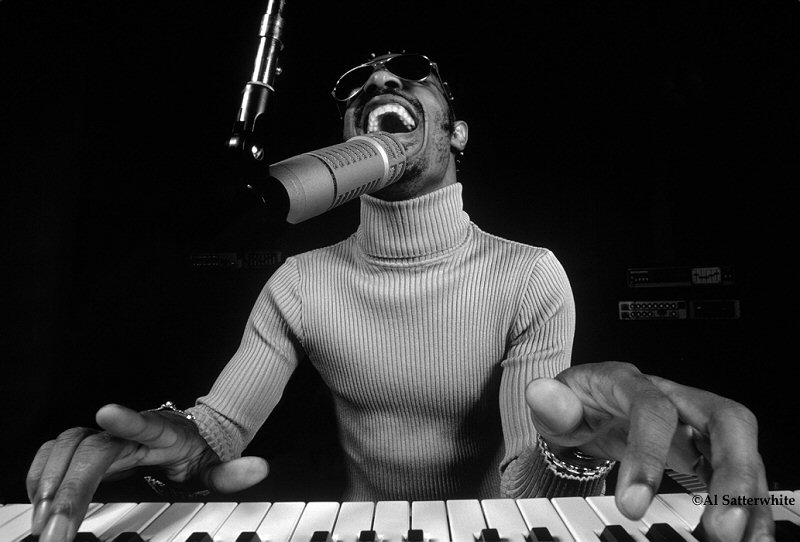
Stevland Hardaway Judkins (b. May 13, 1950), name later changed to Stevland Hardaway Morris, known by his stage name Stevie Wonder, is an American singer-songwriter, multi-instrumentalist, record producer, and activist.
Blind from shortly after birth, Wonder signed with Motown Records' Tamla label at the age of eleven, and continues to perform and record for Motown.
***
Living for the City is a 1973 hit single by Stevie Wonder for the Tamla (Motown) label, from his Innervisions album. Reaching #8 on the Billboard Pop Singles chart and #1 on the R&B chart, the record is driven by a slow bass synth groove (provided by the enormous TONTO modular synthesiser) that manages to exude a certain amount of tension, an appropriate soundscape for the angry social commentary of the song.
Some of Wonder's best known works include singles such as Superstition, Sir Duke, I Wish, and I Just Called to Say I Love You. Well known albums also include Talking Book, Innervisions, and Songs in the Key of Life.
He has recorded more than thirty U.S. top ten hits.
Wonder is also noted for his work as an activist for political causes, including his 1980 campaign to make Martin Luther King, Jr.'s birthday a holiday in the United States.
***
Sir Duke is a song composed and performed by Stevie Wonder, from his 1976 album Songs in the Key of Life. Released as a single in 1977, the track topped the U.S. Billboard Hot 100 and Black Singles charts, and reached #2 in the UK Singles Chart, his biggest hit there at the time.
The song was written in tribute to Duke Ellington, the influential jazz legend who had died in 1974. The lyrics also refer to Count Basie, Glenn Miller, Louis Armstrong and Ella Fitzgerald.
The artists, apart from Stevie Wonder, who perform on the original version were: Raymond Pounds (drums), Nathan Watts (bass), Mike Sembello (lead guitar), Ben Bridges (rhythm guitar), Hank Redd (alto saxophone), Trevor Laurence (tenor saxophone), Raymond Maldonado (trumpet), and Steve Madaio (trumpet).
Wonder re-recorded the song for the 1995 live album Natural Wonder.
Peter Kenneth Frampton (b. April 22, 1950) is an English-American musician, singer, producer, and multi-instrumentalist. He was previously associated with the bands Humble Pie and The Herd. Frampton's international breakthrough album was his live release, Frampton Comes Alive!. The album sold over 6 million copies in the United States alone and spawned several hits. Since then he has released several major albums.
He has also worked with David Bowie and both Matt Cameron and Mike McCready from Pearl Jam, among others. Frampton is best known for such hits as Show Me the Way; Baby, I Love Your Way; Do You Feel Like We Do; and I'm in Yo -- which to this day, remain staples on classic-rock radio. He has also appeared as himself in television shows such as The Simpsons, The Colbert Report, and Family Guy.
***
Show Me the Way is a song written by Peter Frampton, which was originally released on his 1975 album Frampton and as a single, but gained its highest popularity as a song from his 1976 live album Frampton Comes Alive!. The song reached number 6 on the Billboard Hot 100, becoming his biggest hit until I'm in You in 1977.
The song was one of Frampton's earliest to feature the talk box effect, which would become one of his signature sounds.
***
I'm in You is the fifth studio album by Peter Frampton, released in 1977. Frampton returned from touring in 1976 to record this album. Stevie Wonder is also featured.
Under pressure to deliver a studio follow up to one of the biggest selling albums of the decade, Frampton faced a virtually impossible task. He came up with the album I'm in You, recording it at Electric Lady Studios in New York, where Frampton's Camel had been recorded four years earlier, with Frampton demanding bodyguards to protect him from overzealous fans who were going to disrupt the recordings, made even more difficult by the fact that in the two years since he'd cut any new material, he had evolved musically away from some of the sounds on Frampton Comes Alive!
Seven million albums later, he had become a solid lightweight rocker who had set sales records and who would soon find himself welcoming Stevie Wonder, Richie Hayward, Ringo Starr, and Mick Jagger into the studio for his follow-up album.
The result was mostly a surprisingly laid-back album steeped in lyricism and craftsmanship, particularly in its use of multiple overdubs even on the harder rocking numbers.
I'm in You rose to the #2 slot on the Billboard album charts, whose keyboard driven, dominated by the sound of the opening bars Baldwin Piano, ARP String Synthesizer-generated string section, Moog synthesizer, rather than a Guitar, and eventually involves a Gibson Les Paul, and Acoustic Guitar, played by Frampton, it was clear that Frampton was exploring new sides of his music. The title track became his most successful single yet, and the album and same-titled single reached platinum and #2, respectively.
The song Rocky's Hot Club was a novelty song written about Frampton's dog Rocky, who lay across his lap as he wrote the song. On the track Frampton actually plays harmonica, and guitar.
Frank Zappa ridiculed the title track of this album in the song I Have Been in You and in the monologue Is That Guy Kidding or What?
***
I'm in You is the hit title song released by Peter Frampton as a single from his album I'm in You released in 1977. It rose to #2 on the US singles chart, becoming his most successful single.
I'm in You was written by Peter Frampton after returning to New York from touring to record his live album Frampton Comes Alive! in 1976.
The song is about Frampton being recently separated from his first wife, the model Mary Lovett. The song was recorded at Electric Lady Studios in Manhattan's Greenwich Village. Frampton demanded that bodyguards keep overzealous fans from disturbing his recording sessions. This title song is mostly a keyboard driven number, featuring background vocals from Mick Jagger, with the sound of a Baldwin Piano, Moog Synthesizer, ARP String Synthesizer, Gibson Les Paul, Acoustic Guitar, Bass Guitar, Drums, Percussion, and Vocals.
Frank Zappa ridiculed this track in the song I Have Been in You on his album Sheik Yerbouti and in the monologue Is That Guy Kidding or What? on Baby Snakes.
Peter Brian Gabriel (b. February 13, 1950) is an English singer, musician and songwriter who rose to fame as the lead vocalist and flautist of the progressive rock group Genesis.
After leaving Genesis, Gabriel went on to a successful solo career. More recently he has focused on producing and promoting world music and pioneering digital distribution methods for music.
Gabriel was also awarded the Polar Music Prize in 2009 and inducted into the Rock and Roll Hall of Fame as a member of Genesis in 2010.
Kerry Allen Livgren (b. September 18, 1949) is an American musician and songwriter, best known as one of the founding members and primary songwriters for the 1970s progressive rock band, Kansas.
***
Kansas is an American rock band that became popular in the 1970s initially on Album-Oriented Rock charts, and later with hit singles such as Carry On Wayward Son and Dust in the Wind.
They have remained a classic rock radio staple and a popular touring act in North America and Europe.
***
Carry On Wayward Son is a progressive rock single recorded by Kansas and written by Kerry Livgren for their 1976 album Leftoverture. In 1977, the song peaked at #11 on the Billboard pop singles chart, becoming their first Top 40 hit.
The 7" single has been certified Gold by the RIAA. This version was a much shorter version of the song, edited down to 3:26, a version that was also the band's only single to chart in the UK, reaching the top 60 there.
It was also the first 12" single released anywhere by the band when it was released in the UK in that format, though it was the edited version. All initial releases of the single had a B-side of Questions of My Childhood, continuing the tradition of Kansas and many other bands with multiple songwriters of putting a song by the band's other primary writer on the B-side of any single.
This song is 96th on VH1's 100 Greatest Hard Rock Songs.
***
Dust in the Wind is a hit single released by the American progressive rock band Kansas in 1977. It peaked at number six on the Billboard Hot 100 chart the week of April 22, 1978, making it Kansas' only top ten Billboard Hot 100 charting single. The 45-rpm single was certified gold for sales of one million units by the RIAA shortly after the height of its popularity as a hit single. More than 25 years later, the RIAA certified gold the digital download format of the song, Kansas's only single so certified as of September 17, 2008.
Written by Kerry Livgren, it was one of the band's first acoustic tracks; its slow melody and melancholy lyrics differ from their other hits, such as Carry On Wayward Son and The Wall. The guitar part is played by two guitarists on six-string guitars, one in standard tuning and the other in Nashville tuning, in unison to create a chimy sound similar to a twelve-string guitar.
The song's instrumental bridge contains a distinctive and highly memorable melodic line and harmony for violin and viola played by Robby Steinhardt.
Kansas also released a live version of the song on their album Two for the Show.
***
Bruce Frederick Joseph Springsteen (born September 23, 1949), nicknamed "The Boss," is an American singer-songwriter who records and tours with the E Street Band. Springsteen is widely known for his brand of Heartland rock infused with pop hooks, poetic lyrics, and Americana sentiments centered on his native New Jersey.
Springsteen's recordings have included commercially accessible rock albums and somber folk-oriented works. His most successful studio albums, Born to Run and Born in the U.S.A., showcase a talent for finding grandeur in the struggles of daily American life; he has sold more than 65 million albums in the United States and 120 million worldwide[3] and he has earned numerous awards for his work, including 20 Grammy Awards, two Golden Globes and an Academy Award.
Ric Ocasek (b. Richard T. Otcasek, March 23, 1949, Baltimore, MD) is an American of Czechoslovakian heritage, and is a musician, and music producer. He is best known to the public as the former lead vocalist, and rhythm guitarist for the new wave band, The Cars. Ric lived in Baltimore until he was 16, at which time his father, a computer analyst for NASA, was transferred to Cleveland, Ohio. After graduating high school in Cleveland, Ric then attended Bowling Green State University near Toledo, Ohio.
***
The Cars are an American rock band that emerged from the early New Wave music scene in the late 1970's. The band consisted of lead singer and rhythm guitarist Ric Ocasek, lead singer and bassist Benjamin Orr, guitarist Elliot Easton, keyboardist Greg Hawkes and drummer David Robinson. The band originated from Boston, Massachusetts, and were signed to Elektra Records in 1977.
The Cars were at the forefront in merging 1970's guitar-oriented rock with the new synth-oriented pop that was then becoming popular and which would flower in the early 1980s. Robert Palmer, music critic for The New York Times and Rolling Stone, described The Cars' musical style by saying: "they have taken some important but disparate contemporary trends—punk minimalism, the labyrinthine synthesizer and guitar textures of art rock, the '50s rockabilly revival and the melodious terseness of power pop—and mixed them into a personal and appealing blend."
Allmusic reviewer Stephen Thomas Erlewine commented on their style saying "the Cars were nevertheless inspired by proto-punk, garage rock, and bubblegum pop."
The band broke up in 1988, and Ocasek has always discouraged talk of a reunion since then, telling one interviewer in 1997 "I'm saying never and you can count on that."
In 2005, Easton and Hawkes joined with Todd Rundgren to form a spin-off band, The New Cars, which performed classic Cars and Rundgren songs alongside new material. On October 21, 2010, the Cars confirmed that they have reunited and are recording their first album in 23 years. Greg Hawkes will fill in on bass for Benjamin Orr, who died in 2000.
***
My Best Friend's Girl is a song by American rock band The Cars from their 1978 self-titled debut album on Elektra Records. Written by Ric Ocasek and produced by Roy Thomas Baker, the song was released as the album's second single. It peaked at number 35 on the U.S. Hot 100 chart, and reached number three in the UK. My Best Friend's Girl was included on the soundtrack to the 1979 film Over the Edge, and the song appears on numerous compilation albums, such as the band's 1985 Greatest Hits, 1995's Just What I Needed: The Cars Anthology, and 2002's Complete Greatest Hits. A live version of the song by The New Cars appears on their 2006 debut album, It's Alive!.
***
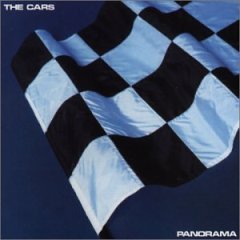
Panorama is the third studio album by American new wave band The Cars, released in 1980. It represented a change from the upbeat, hook-based pop rock of previous albums to a more aggressive and cynical sound. Panorama hit the #5 spot on the Billboard 200 chart.
All songs written by Ric Ocasek (Copyright Lido Music).
Side One
"Panorama" – 5:42 "Touch and Go" – 4:55 "Gimme Some Slack" – 3:32 "Don't Tell Me No" – 4:00 "Getting Through" – 2:35
Side Two
"Misfit Kid" – 4:30 "Down Boys" – 3:09 "You Wear Those Eyes" – 4:55 "Running to You" – 3:22 "Up and Down" – 3:31
Ric Ocasek – rhythm guitar, lead vocals on 1, 2, 3, 5, 6, 10 Elliot Easton – lead guitar, backing vocals Greg Hawkes – keyboards, backing vocals Benjamin Orr – bass, lead vocals on 4, 7, 8, 9 David Robinson – drums, percussion
Ian Anderson Paice (born June 29, 1948) is an English musician, best known as the drummer of the seminal rock band Deep Purple. As of Jon Lord's departure in 2002, he is the only founding member of the band still performing with the group and the only member to appear on every album the band has released.
***
Deep Purple is an English rock band formed in Hertford, UK, in 1968.
Along with Led Zeppelin and Black Sabbath, they are considered to be among the pioneers of heavy metal and modern hard rock, although some band members believe that their music cannot be simply categorised as belonging to any one genre.
The band also incorporated classical, blues-rock, pop, and progressive rock elements.
They were once listed by the Guinness Book of World Records as "the loudest pop group," and have sold over 100 million albums worldwide.
Deep Purple was ranked #22 on VH1's Greatest Artists of Hard Rock programme.
The band has gone through many line-up changes and an eight-year hiatus (1976–84). The 1968–76 line-ups are commonly labelled Mark I, II, III and IV.[10][11] Their second and most commercially successful line-up featured Ian Gillan (vocals), Ritchie Blackmore (guitar), Jon Lord (keyboards), Roger Glover (bass) and Ian Paice (drums).
This line-up was active from 1969 to 1973 and was revived from 1984 to 1989 and again in 1993, before the rift between Blackmore and other members became unbridgeable. The current line-up (including guitarist Steve Morse) has been much more stable, although Lord's retirement in 2002 has left Paice as the only original member never to have left the band.
***
"Smoke on the Water" is a song by the British hard rock band Deep Purple. It was first released on their 1972 album Machine Head. In March 2005, Q magazine placed "Smoke on the Water" at number twelve in its list of the 100 Greatest Guitar Tracks.
***
Rudolf Schenker (born August 31, 1948) is a German guitarist and founding member of heavy metal band Scorpions, being the rhythm/lead guitarist and one of the main song-writers of the band.
After starting out with a Fender Stratocaster, Schenker is primarily known for playing Gibson Flying Vs and, more recently, Dean Vs. In the Acoustica DVD, he is seen playing an acoustic Flying V made especially for him by Dommenget. He now uses Dean acoustic V models.
In an interview on the 'World Wide Live' video, he mentioned that his goal is not to become the best or fastest guitarist, but to be a very good composer.
His younger brother Michael Schenker was a member of Scorpions in the band's earliest inception, before joining the band UFO.
***
Scorpions is a heavy metal/hard rock band from Hannover, Germany, known for their 1980's rock anthem Rock You Like a Hurricane and their singles No One Like You, Send Me an Angel, Still Loving You, and Wind of Change. The band was ranked #46 on VH1's Greatest Artists of Hard Rock program.
Rock You Like a Hurricane is also #18 on VH1's list of the 100 Greatest Hard Rock Songs.
***
[Leadon, Meisner, Henley, Frey]
Glenn Lewis Frey (pronounced Fry; b. November 6, 1948) is an American musician, singer, songwriter, and actor, best known as a founding member of the Eagles.
***
Eagles are an American rock band formed in Los Angeles, California in 1971 by Glenn Frey, Don Henley, Bernie Leadon and Randy Meisner.
With five number one singles, six Grammies, and six number one albums, the Eagles were one of the most successful recording artists of the 1970s. At the end of the 20th century, two of their albums, Their Greatest Hits (1971–1975) and Hotel California, ranked among the 20 best-selling albums in the U.S. according to the Recording Industry Association of America. Hotel California is ranked 37th in Rolling Stone's 500 Greatest Albums of All Time, and the band was ranked #75 on the magazine's 2004 list of the 100 Greatest Artists of All Time.[2] They also have the best selling album in the U.S. with Their Greatest Hits (1971–1975), which sold more than 29 million copies.
The Eagles broke up in July 1980, but reunited in 1994 for Hell Freezes Over, a mix of live and new studio tracks.They have toured intermittently since then, and were inducted into the Rock and Roll Hall of Fame in 1998. In 2007, Eagles released Long Road out of Eden, their first full studio album in 28 years. The album would top the album charts, release five singles on the Adult Contemporary Charts and win the band two grammys. The next year they launched The Long Road out of Eden Tour in support of the album.
***
LaDonna Adrian Gaines (b. December 31, 1948), known by her stage name, Donna Summer is an American singer/songwriter who gained prominence and notoriety during the disco era of the 1970's with the majority of her early work produced by the team of Giorgio Moroder and Pete Belotte.
Summer was the first to have three consecutive double albums reach number one on the US Billboard chart and she had four number-one singles within a thirteen-month period.
***
Bad Girls is the seventh studio album by American pop singer Donna Summer, released April 25, 1979 on Casablanca Records. Originally issued as a double album, it incorporates such musical styles as disco, soul, and rock. Bad Girls became the best-selling album of Summer's recording career, achieving triple platinum sales certification in the United States and ultimately selling near seven million copies worldwide.
***
Bad Girls is a 1979 single released by American singer Donna Summer, co-written by Summer and the Brooklyn Dreams. The inspiration for her to write the song came after one of her assistants was offended by a police officer who thought she was a street prostitute. A rough version of the song had originally been written a couple of years before its release. Neil Bogart, upon hearing it, wanted Donna to give it to Cher for her upcoming album. Donna refused and put it away for a couple of years.
The song became a number-one hit on the Billboard pop, R&B and dance singles charts simultaneously becoming, alongside Hot Stuff, her most successful single. The song helped the album of the same name to reach the multi-platinum status in the United States. A 12" single of the song was released as a medley with Hot Stuff. Although Hot Stuff was extended for the 12" single, Bad Girls remained in the 4:55 album version. A Bad Girls 12" single with a time of 6:55 was produced but never released commercially.
Brian Peter George St. John le Baptiste de la Salle Eno (b. May 15, 1948), commonly shortened to Brian Eno and previously as simply Eno, is an English musician, composer, record producer, music theorist, singer and visual artist, best known as one of the principal innovators of ambient music.
Eno studied at art school, taking inspiration from minimalist painting, but he had little musical education or playing experience when he joined the band Roxy Music as their keyboards and synthesisers player in the early 1970's. Roxy Music's success in the glam rock scene came quickly, but Eno soon tired of conflicts with lead singer Bryan Ferry, and of touring, and he left the group after the release of For Your Pleasure (1973), beginning his solo career with the art rock records Here Come the Warm Jets (1974) and Taking Tiger Mountain (By Strategy) (1974).
Eno extended his reach into more experimental musical styles with No Pussyfooting (1973) and Evening Star (1975), both collaborations with Robert Fripp, The Lamb Lies Down on Broadway (1974) by Genesis where he is credited as Enossification, and his influential solo records Another Green World (1975) and Discreet Music (1975). His pioneering ambient efforts at "sonic landscapes" began to consume more of his time beginning with Ambient 1/Music for Airports (1978) and later Apollo: Atmospheres and Soundtracks (1983) which was composed for the documentary film For All Mankind. Eno nevertheless continued to sing on some of his records, ranging from Before and After Science (1977) to Wrong Way Up (1990) with John Cale to most recently Another Day on Earth (2005).
Eno's solo work has been extremely influential, pioneering ambient and generative music, innovating production techniques, and emphasizing "theory over practice."
He also introduced the concept of chance music to popular audiences partly through collaborations with other musicians.
By the end of the 1970's, Eno had worked with David Bowie on the seminal Berlin Trilogy, helped popularise the American punk rock band Devo and the punk-influenced "No Wave" genre, and worked frequently with Harold Budd, John Cale, Cluster, Robert Fripp and David Byrne, with whom he produced the influential My Life in the Bush of Ghosts (1981). He produced and performed on three albums by Talking Heads, including Remain in Light (1980); produced seven albums for U2, including The Joshua Tree (1987); and worked on records by James, Laurie Anderson, Coldplay, Depeche Mode, Paul Simon, Grace Jones and Slowdive, among others.
Eno pursues multimedia ventures in parallel to his music career, including art installations, a newspaper column in The Observer and a regular column on society and innovation in Prospect magazine, and "Oblique Strategies" (written with Peter Schmidt), a deck of cards in which each card has a cryptic remark or random insight meant to resolve a dilemma. He continues to collaborate with other musicians, produce records, release his own music, and write.
***
My Life in the Bush of Ghosts is a 1981 album by Brian Eno and David Byrne, titled after Amos Tutuola's 1954 novel of the same name. The album was re-released in expanded form in 2006. Receiving strong reviews upon its release, My Life is now regarded as a high point in the discographies of Eno and Byrne.
In a 1985 interview, singer Kate Bush remarked that the album "left a very big mark on popular music," while critic John Bush describes it as a "pioneering work for countless styles connected to electronics, ambience, and Third World music."
The extensive use of sampling on My Life is widely considered ground-breaking -- it was one of the first albums to do so -- but its actual influence on the sample-based music genres that later emerged continues to be debated.
Mark Alburger (b. 1957, Upper Darby, PA) is an award-winning, eclectic ASCAP composer of postminimal, postpopular, and postcomedic sensibilities. He is Music Director of San Francisco Composers Chamber Orchestra and San Francisco Cabaret Opera, Editor-Publisher of 21st-Century Music and New Music, and Professor Emeritus in Music Theory and Literature at Diablo Valley College. His principal teachers were Gerald Levinson, Joan Panetti, and James Freeman at Swarthmore College (B.A.); Jules Langert at Dominican University (M.A.); Christopher Yavelow at Claremont University (Ph.D.); and Terry Riley. Dr. Alburger has composed 406 major works over the past 48 years, including chamber music, concertos, oratorios, operas, song cycles, and symphonies. His complete catalogue is being issued on discs from New Music. Alburger's multiple blogs include: markalburger.blogspot.com,
markalburger2022.blogspot.com,
markalburgerworks.blogspot.com, markalburgerevents.blogspot.com, markalburgermusichistory.blogspot.
com, 21st-centurymusic.blogspot.com