Java (Indonesian: Jawa) is an island of Indonesia and the site of its capital city, Jakarta. Once the centre of powerful Hindu kingdoms and the core of the colonial Dutch East Indies, Java now plays a dominant role in the economic and political life of Indonesia. Housing a population of 130 million in 2006 it is the most populous island in the world, ahead of the nation of Japan. Java is also one of the most densely populated regions on Earth.
Formed mostly as the result of volcanic events, Java is the 13th largest island in the world and the fifth largest island in Indonesia. A chain of volcanic mountains forms an east-west spine along the island. It has three main languages, and most residents are bilingual, with Indonesian as their second language. While the majority of Javanese are Muslim, Java has a diverse mixture of religious beliefs and cultures.
The origins of the name 'Java' are not clear. One possibility is early travellers from India named the island after the jáwa-wut plant, which was said to be common in the island during the time, and that prior to Indianization the island had different names. There are other possible sources: the word jaú and its variations mean "beyond" or "distant." And, in Sanskrit yava means barley, a plant for which the island was famous. Other source states that the "java" word is derived from a Proto-Austronesian root word, meaning "home."
Outsiders often referred to Java and the neighboring islands by the same name, or use names inconsistently for different islands. For example, Marco Polo refers to neighbouring Sumatra as "little Java" and Ptolemy refers to Sumatra as Jaba-diu.
Islam spread into the Indonesian archipelago, including Java, in the thirteenth century. At the time, the Wali Songo (the "nine ambassadors") were the most prominent Muslim evangelists in the region. The spread of Islam (1200–1600) took place first in coastal cities, which developed into Muslim states, such as Sultanate of Demak (1475–1518) and Mataram Sultanate (1500s–1700s).
The music of Java embraces a wide variety of styles, both traditional and contemporary, reflecting the diversity of the island and its lengthy history. Apart from "traditional" forms which maintain connections to musical styles many centuries old, there are also many unique styles and conventions which combine elements from many other regional influences, including those of neighbouring Asian cultures and European colonial forms.
The gamelan orchestra, based on metallic percussion with winds and drums, is perhaps the form which is most readily identified as being distinctly "Javanese" by outsiders. In various forms, it is ubiquitous to Southeast Asia. In Java, the full gamelan also adds a bowed string instrument (the rebab, a name illustrative of Islamic influence) and voices. The rebab is one of the main melodic instruments of the ensemble (together with the xylophone "gendér") and is often played by the senior musician. Voices consist of male and female choruses, together with soloists; however, the voices are not usually featured in court gamelan (as opposed to wayang kulit, shadow puppet theatre) and are supposed to be heard discreetly in the middle of the orchestral sound. In these abstract pieces, the words are largely secondary to the music itself.
The Special Region of Yogyakarta is the smallest province of Indonesia (excluding Jakarta). It is located on the island of Java. It is the only province in Indonesia that is still formally governed by a precolonial Sultanate, the Sultanate of Ngayogyakarta Hadiningrat.
The city of Yogyakarta is the capital of the province.
Yogyakarta is located in south-central Java. It is surrounded by the province of Central Java (Jawa Tengah) and the Indian Ocean in the south. The city is located at 7°47′S, 110°22′E. The population ub 2003 was approximately 3,000,000. The province of Yogyakarta has a total area of 3,185.80 km². Yogyakarta has the second-smallest area of the provinces in Indonesia, after the Jakarta Capital Region. However it has, along with adjacent areas in Central Java, some of the highest population densities of Java.
Located within the Yogyakarta province, Yogyakarta city is known as a center of classical Javanese fine art and culture such as batik, ballet, drama, music, poetry and puppet shows. It is also famous as a center for Indonesian higher education. At Yogyakarta's center is the kraton, or Sultan's palace. While the city sprawls in all directions from the kraton, the core of the modern city is to the north.
Morocco has a coast on the Atlantic Ocean that reaches past the Strait of Gibraltar into the Mediterranean Sea. Morocco has international borders with Algeria to the east, Spain to the north, and Mauritania to the south.
The Arabs invaded Morocco in 682 in the course of their drive to expand the power of Islam. Except for the Jews, the inhabitants of Morocco, both Christian and pagan, soon accepted the religion of their conquerors.
Morocco's music is predominantly Arab, but Andalusian (Medieval Islamic Spanish) and other imported influences have had a major effect on the country's musical character.
Morocco is home to Andalusian classical music that is found throughout North Africa. It probably evolved under the Moors in Cordoba, and the Persian-born musician Ziryab is usually credited with its invention. Ziryab invented the nuba, a suite which forms the basis of al-âla, the primary form of Andalusian classical music today, along with Gharnati and Malhun.
There used to be 24 nuba linked to each hour of the day, but only four nuba have survived in their entirety, and seven in fragmentary form. An entire nuba can last six or seven hours and are divided into five parts called mizan, each with a corresponding rhythm. The rhythms occur in the following order in a complete nuba:
basît (6/4) qaum wa nusf (8/4) darj (4/4) btâyhi (8/4) quddâm (3/4 or 6/8)
Each mizan begins with instrumental preludes called either tuashia, m'shaliya or bughya, followed by as many as twenty songs (sana'a) in the entire mizan.
Andalusian classical schools are spread across Morocco, having left Spain when the Moors and Jews were driven out of the country (1492). Valencia's school is now in Fez, while Granada's is located in Tetouan and Chefchaouen. Cities like Tangier and Meknes have their own orchestras as well.
Jews in Morocco played an important role in the perpetuation of this oral tradition.
Andalusian classical music uses instruments including oud (lute),
[Folk Rebab and Guinbri]
rabab (fiddle),
darbouka (goblet drums),
taarija (tambourine),
[Qanun, Violin, Oud, and Darbouka]
qanún (zither), and kamenjah (violin).
Morocco - Folk Music
From a historical perspective, folk music has at least two prominant characteristics:
It is transmitted through an oral tradition.
The music is often related to national culture.
Lala Fatima
***
Heterophony is a type of texture created through the simultaneous variation of a melodic line. This can refer to a kind of complex monophony in which there is only one basic melody, but realized at the same time in multiple voices, each of which play the melody differently, either in a different rhythm or tempo, or with various embellishments and elaborations. The term (originally coined by Plato) was initially introduced into systematic musicology as a subcategory of polyphonic music, though is now regarded as a textural category in its own right.
Heterophony is often a characteristic feature of non-Western traditional musics -- for example Japanese Gagaku, the gamelan music of Indonesia and the traditional music of Thailand. A remarkably vigorous European tradition of dissonant heterophony exists, however, in the form of Outer Hebridean Gaelic Psalmody.
Thai music is nonharmonic, melodic, or linear, and as is the case with all musics of this genre, its fundamental organization is horizontal... Thai music in its horizontal complex is made up of a main melody played simultaneously with variants of it which progress in relatively slower and faster rhythmic units... Individual lines of melody and variants sound in unison or octaves only at specific structural points, and the simultaneity of different pitches does not follow the Western system of organized chord progressions. Between the structural points where the pitches coincide (unison or octaves) each individual line follows the style idiomatic for the instrument playing it. The vertical complex at any given intermediary point follows no set progression; the linear adherence to style regulates. Thus several pitches that often create a highly complex simultaneous structure may occur at any point between the structural pitches.
The music 'breathes' by contracting to one pitch, then expanding to a wide variety of pitches, then contracting again to another structural pitch, and so on throughout. Though these complexes of pitches between structural points may strike the Western listener as arbitrary and inconsequential, the individual lines are highly consequential and logical linearly. The pattern of pitches occurring at these structural points is the basis of the modal aspect of Thai music.
Heterophony is somewhat rare in Western Classical music prior to the 20th Century, but is frequently encountered in the music of composers such as Claude Debussy and Igor Stravinsky, who were directly influenced by non-Western (and largely heterophonic) music. The texture became a standard technique in the music of the post-war avant garde, in such works as Olivier Messiaen's Sept Haïkaï (1962), Pierre Boulez's Rituel: In Memoriam Bruno Maderna (1975), and Harrison Birtwistle's Pulse Shadows (1996). Benjamin Britten used heterophony in many of his compositions, notably in ThreeChurch Parables: Curlew River, The Burning Fiery Furnace, and The Prodigal Son.
Syria is significant in the history of Christianity; Paul was converted on the Road to Damascus and established the first organized Christian Church at Antioch in ancient Syria, from which he left on many of his missionary journeys. Roman/Byzantine rule continued from this time through the early AD 600's.
In 616 Syria was subjugated for a brief period by the Persian Khosrau II; from 622 till 628 it was again Byzantine; 636 and the immediately following years saw its conquest by the Muslims in the Battle of Yarmuk.
[Middle Eastern Instruments, including Ud and Qanun (both at back, leaning against wall)]
Maqam with Qanun and Ud
Arabic maqām ( pl. maqāmāt or maqams) is the system of melodic modes used in traditional Arabic music, which is mainly melodic. The word maqam in Arabic means place, location or rank. The Arabic maqam is a melody type. Each maqam is built on a scale, and carries a tradition that defines its habitual phrases, important notes, melodic development and modulation. Both compositions and improvisations in traditional Arabic music are based on the maqam system. Maqams can be realized with either vocal or instrumental music, and do not include a rhythmic component.
The designation maqam appeared for the first time in the treatises written in the 14th Century by Al-Sheikh Al-Safadi and Abdulqadir Al-Maraghi, and has since then been used as a technical term in Arabic music. The maqam is a modal structure that characterizes the art of music of countries in North Africa, the Near East and Central Asia. In this area we can distinguish three main musical cultures which all belong to the modal family, namely the Turkish, the Greek, the Persian and the Arabic.
Arabic maqams are based on a musical scale of seven notes that repeats at the octave. Some maqams have two or more alternative scales (e.g. Rast, Nahawand, and Hijaz). Maqam scales in traditional Arabic music are microtonal, not based on a 12-tone equal-tempered musical tuning system, as is the case in modern Western Music. Most maqam scales include a perfect fifth or a perfect fourth (or both), and all octaves are perfect. The remaining notes in a maqam scale may or may not exactly fall on semitones. For this reason maqam scales are mostly taught orally, and by extensive listening to the traditional Arabic music repertoire.
The qanún or kanun (qānūn, from Greek ''measuring rod"; "rule" "cane") is a string instrument found in Near Eastern traditional music based on Maqamat. It is basically a zither with a narrow trapezoidal soundboard. Strings are stretched over a single bridge poised on fish-skins on one end, attached to tuning pegs at the other end.
Kanuns are played on the lap by plucking the strings with two tortoise-shell picks, one in each hand, or by the fingernails, and has a range of three and a half octaves, from A2 to E6.
Arabic qanuns employ quarter-tones.
The kanun is a descendant of the old Egyptian harp, and is related to the psaltery, dulcimer and zither.
The oud (ūd; Somali: Kaban; Persian: barbat; Turkish: ud or ut; Greek: ούτι; Azeri: ud; Hebrew: ud) is a pear-shaped, stringed instrument, which is often seen as the predecessor of the western lute, distinguished primarily by being without frets, commonly used in Middle Eastern music.
The words "lute" and "oud" are both derived from Arabicد (al-ʿūd, elided, perhaps "lud" or "lute"), consisting of the Arabic letters ʿayn-wāw-dāl, meaning a thin piece of wood similar to the shape of a straw, referring either the to wood plectrum used traditionally for playing the lute, or to the thin strips of wood used for the back, or for the fact that the top was made of wood, not skin as were earlier.
However, recent research by Eckhard Neubauer suggests that ʿūd may simply be an Arabized version of the Persian name rud, which meant string, stringed instrument, or lute. Gianfranco Lotti suggests that the "wood" appellation originally carried derogatory connotations, because of proscriptions of all instruments music in early Islam.
The Arabic prefix al-, in al-ʿūd, which represents the definite article and can be translated as "the," was not retained when al-ʿūd, was borrowed into Turkish, nor was the ʿayn, as it is not a sound existing in the Turkish language. The resulting word in Turkish is simply ud (pronunciation follows that of the word food without the f ), much as it sounds when pronounced in the English language.
According to Iranian philosopher-musicologist Al Farabi, the oud was invented by Lamech, the sixth grandson of Adam [!]. The legend tells that the grieving Lamech hung the body of his dead son from a tree. The first oud was inspired by the shape of his son's bleached skeleton [!!].
The oldest pictorial record of a lute dates back to the Uruk period in Southern Mesopotamia - Iraq - Nasria, over 5000 years ago on a cylinder seal acquired by Dr. Dominique Collon and currently housed at the British Museum. The image depicts a female crouching with her instruments upon a boat, playing right-handed. This instrument appears many times throughout Mesopotamian history and again in ancient Egypt from the 18th dynasty onwards in long and short-neck varieties. One may see such examples at the Metropolitan Museums of New York, Philadelphia, Cleveland, and the British Museum on clay tablets and papyrus paper. This instrument and its close relatives have been a part of the music of each of the ancient civilizations that have existed in the Mediterranean and the Middle East regions, including the Sumerians, Akkadians, Persians, Babylonians, Assyrians, Armenians, Greeks, Egyptians, and Romans.
The ancient Turkic peoples had a similar instrument called the kopuz. This instrument was thought to have magical powers and was brought to wars and used in military bands. This is noted in the Göktürk monument inscriptions, the military band was later used by other Turkic state's armies and later by Europeans
Defining features
Lack of Frets: The oud, unlike many other plucked stringed instruments, does not have a fretted neck. This allows the player to be more expressive by using slides and vibrato. It also makes it possible to play the microtones of the Maqam System. This development is relatively recent, as ouds still had frets c. 1100, and they gradually lost them by AD 1300, mirroring the general development of Near-Eastern music which abandoned harmony in favor of melismatics.
Strings: With some exceptions, the modern oud has eleven strings. Ten of these strings are paired together in courses of two. The eleventh, lowest string remains single. There are many different tuning systems for the oud which are outlined below. The ancient oud had only four courses - five by the 9th century. The strings are generally lighter to play than the modern classical guitar.
Pegbox: The pegbox of the oud is bent back at a 45-90° angle from the neck of the instrument. This provides the necessary tension that prevents the pegs from slipping. Body: The oud's body has a staved, bowl-like back resembling the outside of half a watermelon, unlike the flat back of a guitar. This bowl allows the oud to resonate and have a more complex tone.
Sound-holes: The oud generally has one to three sound-holes, which may be either oval or circular, and often are decorated with a bone or wood carved rosette.
The following are the general regional characteristics of oud types in which both the shape and the tuning most commonly differ:
Syrian ouds: Slightly larger, slightly longer neck, lower in pitch.
Iraqi (Munir Bashir type) ouds: Generally similar in size to the Syrian oud but with a floating bridge which focuses the mid-range frequencies and gives the instrument a more guitar-like sound. This kind of oud was developed by the Iraqi oud virtuoso Munir Bechir. Iraqi ouds made today often feature 13 strings, adding a pair of higher pitched nylon strings to a standard Arabic oud configuration.
Egyptian ouds: Similar to Syrian and Iraqi ouds but with a more pear shaped body. Slightly different tone. Egyptians commonly are set up with only the 5 courses GADGC. Egyptian Ouds tend to be very ornate and highly decorated.
Barbat (Persian Oud): smaller than Arabic ouds with different tuning and higher tone. Similar to Turkish ouds but slightly smaller.
Oud Qadim: an archaic type of oud from North Africa, now out of use.
Although the Greek instruments Laouto and Lavta appear to look much like an oud, they are very different in playing style and origin, deriving from Byzantine lutes. The laouto is mainly a chordal instrument, with occasional melodic use in Cretan music. Both always feature movable frets (unlike the oud).
Shepherd's Tune
Pipe describes a number of musical instruments, historically referring to perforated wind instruments. The word is an onomotopoeia, and comes from the tone which can resemble that of a bird chirping.
Fipple flutes are found in many cultures around the world. Often with six holes, the shepherd's pipe is a common pastoral image. Shepherds often piped both to soothe the sheep and to amuse themselves. Modern manufactured six-hole folk pipes are referred to as pennywhistle or tin whistle. The recorder is a form of pipe, often used as a rudimentary instructional musical instrument at schools, but so versatile that it is also used in orchestral music, but it has seven finger holes and a thumb hole.
Senegal is south of the Sénégal River in Western Africa, bounded by the Atlantic Ocean to the west, Mauritania to the north, Mali to the east, and Guinea and Guinea-Bissau to the south. The Gambia lies almost entirely within Senegal, surrounded on the north, east and south; from its western coast, Gambia's territory follows the Gambia River more than 186 miles inland. Dakar is the capital city of Senegal, located on the Cape Verde Peninsula on the country's Atlantic coast.
Archaeological findings throughout the area indicate that Senegal was inhabited in prehistoric times.
Prehistory is a term often used to describe the period before written history. Paul Tournal originally coined the term Pré-historique in describing the finds he had made in the caves of southern France. It came into use in French in the 1830's to describe the time before writing, and was introduced into English by Daniel Wilson in 1851.
Prehistory can be said to date back to the beginning of the universe itself, although the term is most often used to describe periods when there was life on Earth; dinosaurs can be described as prehistoric animals and cavemen are described as prehistoric people. Usually the context implies what geologic or prehistoric time period is discussed, e.g. "Middle Palaeolithic Homo sapiens," 20,0000 years ago.
[Village near Podor]
Senegal - Greetings from Podor
[19th-Century French fort at Podor]
Podor is the northernmost town in Senegal, Africa, lying on Morfil Island between the Sénégal River and Doué River.
***
[Idiophones from Southeast Asia]
A solid-body percussion instrument, or idiophone, is any musical instrument which creates sound primarily by way of the instrument vibrating itself, without the use of strings or membranes. It is one of the four main divisions in the original Hornbostel-Sachs scheme of musical instrument classification. Idiophones are probably the oldest type of musical instrument (not counting the human voice). In the early classification of Victor-Charles Mahillon, this group of instruments was called autophones.
Most percussion instruments which are not drums are idiophones. Hornbostel-Sachs divides idiophones into four main sub-categories. The first division is the struck idiophones (sometimes called concussion idiophones). This includes most of the non-drum percussion instruments familiar in the west. They include all idiophones which are made to vibrate by being hit, either directly with a stick or hand (like the wood block, singing bowl, triangle or marimba), or indirectly, by way of a scraping or shaking motion (like maracas or flexatone).
Various types of bells fall into both categories.
The other three sub-divisions are rarer. They are plucked idiophones, such as the jew's harp, amplified cactus, music box or mbira (thumb piano); blown idiophones, of which there are a very small number of examples, the Aeolsklavier being one; and friction idiophones, such as the singing bowl, glass harmonica, glass harp, turntable, verrophone, daxophone, styrophone, musical saw, or nail violin (a number of pieces of metal or wood rubbed with a bow).
A number of idiophones that are normally struck, such as vibraphone bars and cymbals, can also be bowed.
***
The drum, or membranophone, consists of at least one membrane, called a drumhead or drum skin, that is stretched over a shell and struck, either directly with parts of a player's body, or with some sort of implement such as a drumstick, to produce sound. Drums are the world's oldest and most ubiquitous musical instruments, and the basic design has remained virtually unchanged for thousands of years. Most drums are considered "untuned instruments."
The shell almost invariably has a circular opening over which the drumhead is stretched, but the shape of the remainder of the shell varies widely. In the western musical tradition, the most usual shape is a cylinder, although timpani, for example, use bowl-shaped shells. Other shapes include a frame design (tar, Bodhrán), truncated cones (bongo drums, Ashiko), goblet shaped (djembe), and joined truncated cones (talking drum).
Drums with cylindrical shells can be open at one end (as is the case with timbales), or can have two drum heads. Single-headed drums normally consist of a skin which is stretched over an enclosed space, or over one of the ends of a hollow vessel. Drums with two heads covering both ends of a cylindrical shell often have a small hole somewhat halfway between the two heads; the shell forms a resonating chamber for the resulting sound. Exceptions include the African slit drum, made from a hollowed-out tree trunk, and the Caribbean steel drum, made from a metal barrel. Drums with two heads can also have a set of wires, called snares, held across the bottom head, top head, or both heads, hence the name snare drum.
Prior to the invention of tension rods drum skins were attached and tuned by rope systems such as that used on the Djembe or pegs and ropes such as that used on Ewe Drums.
Several factors determine the sound a drum produces, including the type of shell the drum has, the type of drumheads it has, and the tension of the drumheads. Different drum sounds have different uses in music. For example, a jazz drummer may want drums that sound crisp, clean, and a little on the soft side, whereas a rock and roll drummer may prefer drums that sound loud and deep. Because these drummers want different sounds, their drums will be constructed differently.
The drumhead has the most effect on how a drum sounds. Each type of drumhead serves its own musical purpose and has its own unique sound. Thicker drumheads are lower-pitched and can be very loud. Drumheads with a white plastic coating on them muffle the overtones of the drumhead slightly, producing a less diverse pitch. Drumheads with central silver or black dots tend to muffle the overtones even more. And drumheads with perimeter sound rings mostly eliminate overtones . Some jazz drummers avoid using thick drumheads, preferring double ply drumheads or drumheads with perimeter sound rings. Rock drummers often prefer the thicker or coated drumheads.
The second biggest factor affecting the sound produced by a drum is the tension at which the drumhead is held against the shell of the drum. When the hoop is placed around the drumhead and shell and tightened down with bolts, the tension of the head can be adjusted. When the tension is increased, the amplitude of the sound is reduced and the frequency is increased, making the pitch higher and the volume lower.
The type of shell also affects the sound of a drum. Because the vibrations resonate in the shell of the drum, the shell can be used to increase the volume and to manipulate the type of sound produced. The larger the diameter of the shell, the lower the pitch of the drum will be. The type of wood is important as well. Birch generates a bright, crisp, and clean sound, maple reproduces the frequency of the drumhead as it resonates and has a warm, wholesome sound while mahogany raises the frequency of low pitches and keeps higher frequencies at about the same speed. When choosing a set of shells, a jazz drummer may want smaller maple shells, while a rock drummer may want larger birch shells. For more information about tuning drums or the physics of a drum, visit the external links listed below.
Drums are usually played by the hands, or by one or two sticks. In many traditional cultures drums have a symbolic function and are often used in religious ceremonies. Drums are often used in music therapy, especially hand drums, because of their tactile nature and easy use by a wide variety of people.
The earliest known drum-like instrument is from Mezhirich, near Kiev, Ukraine, and dates back to approximately 15,000 years ago. The instrument was found at the site of the oldest known house, constructed of mammoth bones. They were found in 1965 by a farmer digging a new basement six feet below the ground. The drum-like instrument is a hollow mammoth skull with signs of wear from being hit by mammoth bones decorated with red paint.
In the past drums have been used not only for their musical qualities, but also as a means of communication, especially through signals. The talking drums of Africa can imitate the inflections and pitch variations of a spoken language and are used for communicating over great distances. Throughout Sri Lankan history drums have been used for communication between the state and the community, and Sri Lankan drums have a history stretching back over 2500 years. Japanese troops used Taiko drums to motivate troops, to help set a marching pace, and to call out orders or announcements. Fife-and-drum corps of Swiss mercenary foot soldiers also used drums. They used an early version of the snare drum carried over the player's right shoulder, suspended by a strap (typically played with one hand using traditional grip). It is to this instrument that English word "drum" was first used.
***
Rhythm (from Greek - rhythmos, "any measured flow or movement, symmetry") is the variation of the length and accentuation of a series of sounds or other events.
***
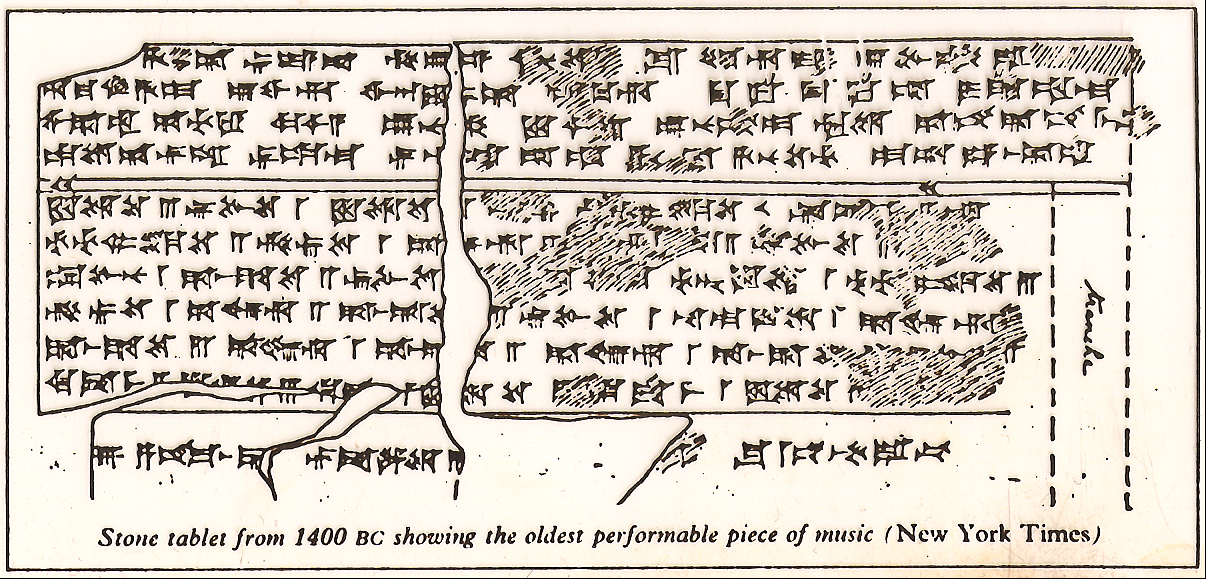
The earliest performable notation comes from Iraq, West Asia (Sumeria, 1400 BC), using letter names for pitch (Korea, in Northwest Asia, developed a related notion).
In Western Europe, a repeating 7-letter notation (ABCDEFGABC....) became supplemented by graphics. Medieval monks began with squiggles called neumes, read left to right through time, with pitch depicted as high or low on the page.
Horizontal staff lines were added, with a clef, specifying a pitch,
such as "G," for high (treble) singers.
***
A clef (from the French for "key") is a musical symbol used to indicate the pitch of written notes.
Placed on one of the lines at the beginning of the staff, it indicates the name and pitch of the notes on that line. This line serves as a reference point by which the names of the notes on any other line or space of the staff may be determined.
These days, the curlicues of the G-clef are almost invariably placed on the second line (from the bottom) of the staff, and is called the "treble clef." This is by far the most common clef used today, and the only G-clef still in use. For this reason, the terms G-clef and treble clef are basically seen as synonymous. It was formerly also known as the "violin clef."
This clef is used for the bagpipes, violin, flutes, oboe, English horn, all clarinets, all saxophones, horn, euphonium (occasionally), trumpet, guitar, vibraphone, xylophone and handbells; for the upper part of keyboard instruments like the piano, organ, harp, and harpsichord (of which the lower part is usually written in the bass clef); for the highest notes played by the cello (the old convention was to write an octave higher, unless preceded by a tenor clef), bassoon, trombone (which otherwise use the bass and tenor clefs), and viola (which otherwise uses the alto clef); and for the soprano, mezzo-soprano, alto, and tenor voices.
***
Squarish neumes with four lines became notes on a five-line staff.
Quarter notes (and their equivalent silent counterparts known as rests) often receive one "beat" or time unit, at any designated speed (tempo, time).
Vertical bar lines were added for measured intervals of time -- the space between bar lines called a "measure." Repeat signs save space, thin double bars end sections, and double bars end pieces.
The repeated notes in Greetings from Podor, could be notated as Middle C Quarter Notes. As the main notes of the piece, they could also be called "I" or "Do." This C is on a ledger line, just below the five-note staff...
Middle C is indeed roughly in the center of a piano keyboard. Any note adjacent to the left of a "gang of two" black notes will be a C.
2/4, 3/4, and 4/4 are meters (time signature). All the notes above are High C's, one octave (eight white notes above Middle C).
"3/4" means 3 beats per measure, with the quarter (1/4) note getting the beat.
The above example shows quarter notes, eighths (half as long as quarters), and sixteenth notes (half as long as eighths).
Other important notes and rests include the half (twice as long as a quarter)
and the whole (twice as long as a half, four times as long as a quarter).
***
Tempo (Italian for 'time, movement') is the speed or pace of a given piece. It is an extremely crucial element of sound, as it can affect the mood and difficulty of a piece.
The plural of tempo in Italian is tempi. Some writers employ this plural when writing in English. Others use the native English plural tempos. Standard dictionaries reflect both usages.
The tempo of a piece will typically be written at the start of a piece of music, and is usually indicated in beats per minute (mm metronome marks). This means that a particular note value (for example, a quarter note) is specified as the beat, and the marking indicates that a certain number of these beats must be played per minute. The greater the tempo, the larger the number of beats that must be played in a minute is and, therefore, the faster a piece must be played. Mathematical tempo markings of this kind became increasingly popular during the first half of the 19th century, after the metronome had been invented by Johann Nepomuk Mälzel, although early metronomes were somewhat inconsistent. Some people consider Beethoven's metronome markings, in particular, to be notoriously unreliable.
As an alternative to metronome markings, some 20th century composers (such as Béla Bartók and John Cage) would give the total execution time of a piece, from which the proper tempo can be roughly derived.
Whether a music piece has a mathematical time indication or not, in classical music it is customary to describe the tempo of a piece by one or more words. Most of these words are Italian, a result of the fact that many of the most important composers of the 17th century were Italian, and this period was when tempo indications were used extensively for the first time.
Before the metronome, words were the only way to describe the tempo of a composition. Yet after the metronome's invention, these words continued to be used, often additionally indicating the mood of the piece, thus blurring the traditional distinction between tempo and mood indicators. For example, presto and allegro both indicate a speedy execution (presto being faster), but allegro also connotes joy (from its original meaning in Italian). Presto, on the other hand, indicates speed as such (while possibly connoting virtuosity, a connotation it did not acquire until the late 18th century).
Additional Italian words also indicate tempo and mood. For example, the "agitato" in the Allegro agitato of the last movement of George Gershwin's piano concerto in F has both a tempo indication (undoubtedly faster than a usual Allegro) and a mood indication ("agitated").
In some cases (quite often up to the end of the Baroque period), conventions governing musical composition were so strong that no tempo had to be indicated. For example, the first movement of Bach's Brandenburg Concerto No. 3 has no tempo or mood indication whatsoever.
To provide movement names, publishers of recordings resort to ad hoc measures, for instance marking the Brandenburg movements "Allegro," "(Allegro)," "(Without indication)," and so on.
In Renaissance music most music was understood to flow at a tempo defined by the tactus, roughly the rate of the human heartbeat. Which note value corresponded to the tactus was indicated by the mensural time signature.
Often a particular musical form or genre implies its own tempo, so no further explanation is placed in the score. Thus musicians expect a minuet to be performed at a fairly stately tempo, slower than a Viennese waltz; a Perpetuum Mobile to be quite fast, and so on. Genres can be used to imply tempos; thus Ludwig van Beethoven wrote "In tempo d'un Menuetto" over the first movement of his Piano Sonata, Op. 54, although that movement is not a minuet. Popular music charts use terms such as "bossa nova", "ballad", and "Latin rock" in much the same way.
It is important to remember when interpreting these words that not only have tempos changed over historical time, and even in different places, but sometimes even the ordering of terms has changed. Thus a modern largo is slower than an adagio, but in the Baroque period it was faster.
From fastest to slowest, the common tempo markings are:
Prestissimo - extremely fast
Vivacissimamente - adverb of vivacissimo, "very quickly and lively"
Vivacissimo - very fast and lively
Presto - very fast
Allegrissimo - very fast
Vivo - lively and fast
Vivace - lively and fast
Allegro (Italian "happy") - fast and bright
Allegro moderato - moderately quick
Allegretto (a "little allegro") - moderately fast (but less so than allegro)
Allegretto grazioso - moderately fast and with grace
Moderato - moderately
Moderato con espressivo - moderately with expression
Andantino - alternatively faster or slower than andante (a rather ambiguous tempo)
Andante - at a walking pace
Tranquillamente - adverb of tranquillo, "tranquilly"
Tranquillo - tranquil
Adagietto - rather slow
Adagio - slow and stately (literally, "at ease")
Grave - slow and solemn
Larghetto - rather broadly
Largo - Very slow, very similar to lento
Lento - very slow
Largamente/Largo - "broadly," very slow
Larghissimo - very slow
Other terms include:
Marcato - marching tempo
Misterioso - mysteriously
Tempo commodo - at a comfortable speed
Tempo giusto - at a consistent, or exact, speed
L'istesso tempo - at the same speed (as before)
Non troppo - not too much (e.g. Allegro ma non troppo, "fast but not too much")
Assai - rather, very, enough as is needed (e.g. Adagio assai)
Con - with (e.g. Andante con moto, "at a walking pace with motion")
Molto - much, very (e.g. Molto allegro)
Poco - a little (e.g. Poco allegro)
Quasi - as if (e.g. Più allegro quasi presto, "faster, as if presto")
tempo di... - the speed of a ... (e.g. Tempo di valse (speed of a waltz), Tempo di marzo/marcia (speed of a march))
All of these markings are based on a few root words such as allegro, largo, adagio, vivace, presto, andante, and lento. By adding the -issimo ending the word is amplified, by adding the -ino ending the word is diminished, and by adding the -etto ending the word is endeared. Many tempos also can be translated with the same meaning, and it is up to the player to interpret the speed that best suits the period, composer, and individual work.
Common qualifiers
assai - very, very much, as in Allegro assai (but also understood by some as "enough")
con brio - with vigour or spirit
con moto - with movement
non troppo - not too much, e.g. Allegro non troppo (or Allegro ma non troppo) means "Fast, but not too much."
non tanto - not so much
molto - much, very, as in Molto allegro (very fast and bright) or Adagio molto
poco - slightly, little, as in Poco adagio
più - more, as in Più allegro; used as a relative indication when the tempo changes
meno - less, as in Meno presto
poco a poco - little by little
In addition to the common allegretto, composers freely apply Italian diminutive and superlative suffixes to various tempo indications: andantino, larghetto, adagietto, and larghissimo.
Some markings that primarily mark a mood (or character) also have a tempo connotation:
Agitato - agitated, with implied quickness
Appasionato - to play passionately
Dolce - sweetly
Espressivo - expressively
Furioso - to play in an angry or furious manner
Giocoso - merrily
Maestoso - majestic or stately (which generally indicates a solemn, slow movement)
Morendo - dying
Sostenuto - sustained, sometimes with a slackening of tempo
Scherzando - playful
Vivace - lively and fast
Composers may use expressive marks to adjust the tempo:
Accelerando - speeding up (abbreviation: accel.)
Allargando - growing broader; decreasing tempo, usually near the end of a piece
Meno mosso - less movement or slower
Mosso - movement, more lively, or quicker, much like più mosso, but not as extreme
Più mosso - more movement or faster
Rallentando - slowing down, especially near the end of a section (abbreviation: rall.)
Ritardando - slowing down (abbreviation: rit. or more specifically, ritard.)
Ritenuto - slightly slower; temporarily holding back. (Note that the abbreviation for ritardando can also be rit. Thus a more specific abbreviation is riten. Also sometimes ritenuto does not reflect a tempo change but a character change instead.)
Rubato - free adjustment of tempo for expressive purposes
Stretto - rushing ahead; temporarily speeding up
Stringendo - pressing on faster
While the base tempo indication (such as allegro) appears in large type above the staff, these adjustments typically appear below the staff or (in the case of keyboard instrument) in the middle of the grand staff.
They generally designate a gradual change in tempo; for immediate tempo shifts, composers normally just provide the designation for the new tempo. (Note, however, that when Più Mosso or Meno Mosso appears in large type above the staff, it functions as a new tempo, and thus implies an immediate change.) Several terms control how large and how gradual this change are:
poco a poco - bit by bit, gradually
subito - suddenly
poco - a little
molto - a lot
assai - quite a lot, very
After a tempo change, a composer may return to a previous tempo in two different ways:
a tempo - returns to the base tempo after an adjustment (e.g. "ritardando ... a tempo" undoes the effect of the ritardando).
Tempo primo or Tempo I - denotes an immediate return to the piece's original base tempo after a section in a different tempo (e.g. "Allegro ... Lento ... Tempo I" indicates a return to the Allegro). This indication often functions as a structural marker in pieces in binary form.
These terms also indicate an immediate, not a gradual, tempo change. Although they are Italian, composers typically use them even if they have written their initial tempo marking in some other language.
Although Italian has been the prevalent language for tempo markings throughout most of classical music history, many composers have written tempo indications in their own language.
Several composers have written markings in French, among them baroque composers François Couperin and Jean-Philippe Rameau as well as Claude Debussy, Olivier Messiaen, Maurice Ravel and Alexander Scriabin. Common tempo markings in French are:
Rapide - fast
Vite - fast
Vif - lively
Très - very, as in Très vif (very lively)
Modéré - at a moderate tempo
Moins - less, as in Moins vite (less fast)
Lent - slowly
Grave - slowly and solemnly
Au mouvement - play the (first or main) tempo.
Many composers (including Gustav Mahler and Arnold Schoenberg) have used German tempo markings. Typical German tempo markings are:
Schnell — fast
Rasch — quickly
Lebhaft — lively (mood)
Mäßig — moderately
Langsam — slowly
One of the first German composers to use tempo markings in his native language was Ludwig van Beethoven. The one using the most elaborate combined tempo and mood markings was probably Gustav Mahler. For example, the second movement of his Symphony No. 9 is marked Im tempo eines gemächlichen Ländlers, etwas täppisch und sehr derb, indicating a slowish folk-dance–like movement, with some awkwardness and vulgarity in the execution. Mahler would also sometimes combine German tempo markings with traditional Italian markings, as in the first movement of his Symphony No. 6, marked Allegro energico, ma non troppo. Heftig, aber markig.
English indications, for example quickly, have also been used, by Benjamin Britten and Percy Grainger, among many others.
***
Meter is a concept related to an underlying division of time, the measurement of a musical line into measures of stressed and unstressed "beats," indicated in Western music notation by a symbol called a time signature.
Ametric music includes chant, some graphically scored works since the 1950's, and non-European music such as Honkyoku repertoire for shakuhachi.
Polymeter or Polyrhythm is the use of two or more metric frameworks simultaneously, or in regular alternation
[1990 France Pitch / 1988 Senegal Rhythm / 1987 France Aerophone]
Mark Alburger (b. 1957, Upper Darby, PA) is an award-winning, eclectic ASCAP composer of postminimal, postpopular, and postcomedic sensibilities. He is Music Director of San Francisco Composers Chamber Orchestra and San Francisco Cabaret Opera, Editor-Publisher of 21st-Century Music and New Music, and Professor Emeritus in Music Theory and Literature at Diablo Valley College. His principal teachers were Gerald Levinson, Joan Panetti, and James Freeman at Swarthmore College (B.A.); Jules Langert at Dominican University (M.A.); Christopher Yavelow at Claremont University (Ph.D.); and Terry Riley. Dr. Alburger has composed 406 major works over the past 48 years, including chamber music, concertos, oratorios, operas, song cycles, and symphonies. His complete catalogue is being issued on discs from New Music. Alburger's multiple blogs include: markalburger.blogspot.com,
markalburger2022.blogspot.com,
markalburgerworks.blogspot.com, markalburgerevents.blogspot.com, markalburgermusichistory.blogspot.
com, 21st-centurymusic.blogspot.com